Brick and Block Dimensions: Standard Sizes, Measurements & Size Chart
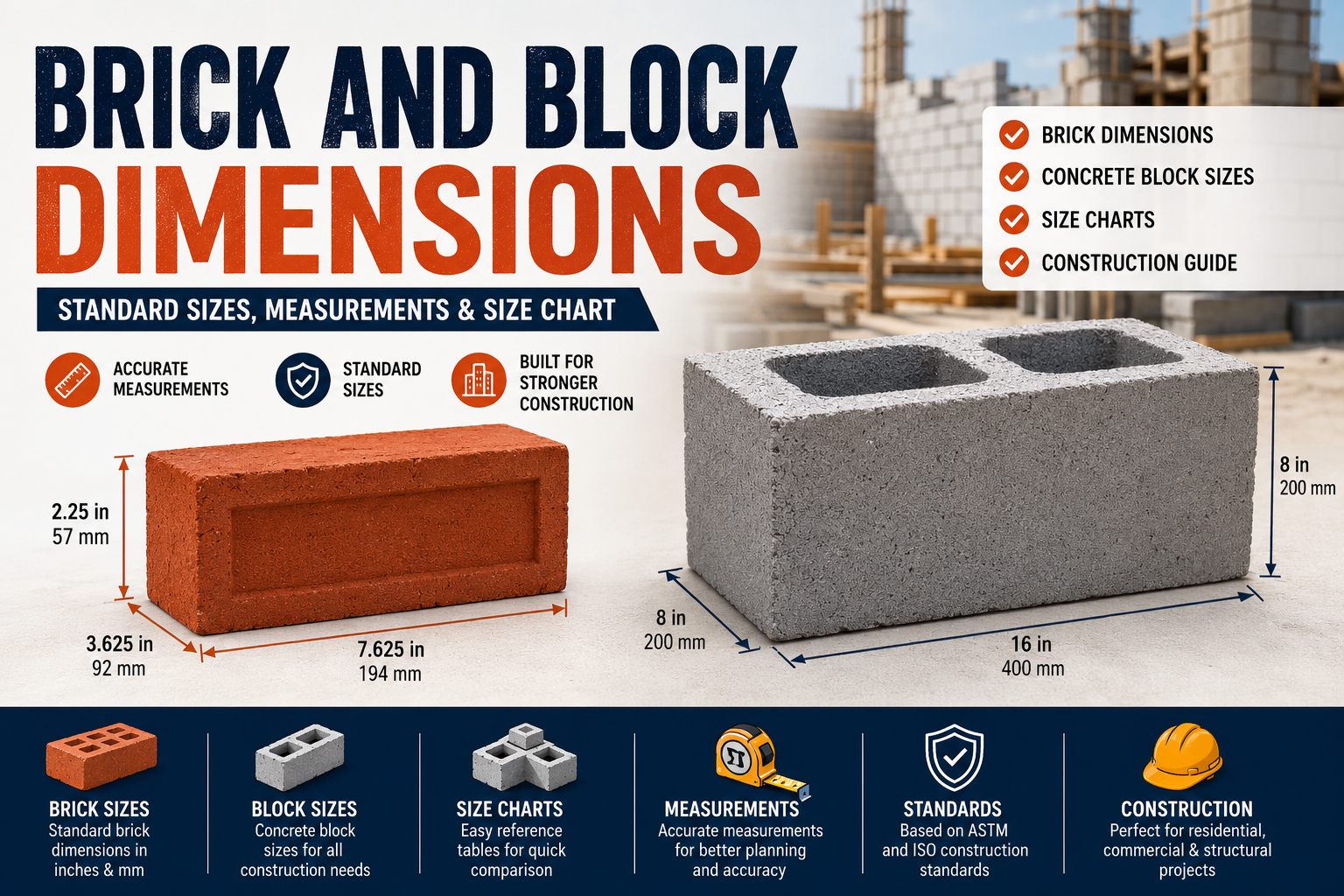
Understanding Brick and Block Dimensions is essential for architects, builders, contractors, and homeowners. Whether you’re constructing a house, planning a renovation, or estimating building materials, knowing the standard sizes of bricks and concrete blocks helps improve accuracy, reduce waste, and ensure compliance with construction standards.
Bricks and blocks come in various sizes depending on the country, manufacturer, and building requirements. This guide explains the most common brick and block dimensions, compares different types, and provides easy-to-read conversion charts to help you choose the right materials for your next construction project.
Understanding Brick and Block Dimensions
Bricks and blocks are among the oldest and most widely used building materials. Although they serve similar purposes, their dimensions, weight, and applications can differ significantly.
A brick is usually made from clay, shale, or concrete and is smaller in size, making it suitable for detailed masonry work and decorative finishes.
A block, also known as a Concrete Masonry Unit (CMU), is larger and is primarily used for structural walls, foundations, retaining walls, and commercial construction.
Because these materials vary by region, manufacturers often follow national or international standards to ensure consistency
Why Standard Brick Dimensions Matter
Using standard-sized bricks and blocks offers several important benefits.
Improved Construction Accuracy
Standard dimensions simplify planning, reduce cutting, and ensure walls remain level and structurally sound.
Faster Installation
Uniform sizes help masons work more efficiently because each unit fits consistently with standard mortar joints.
Better Material Estimation
Knowing the exact dimensions makes it easier to estimate:
- Number of bricks required
- Quantity of mortar
- Wall area coverage
- Transportation costs
Compliance with Building Standards
Many building codes recommend or require standardized masonry units to maintain safety and structural performance.
Learn Standard steel beam sizes commonly used in commercial and public building construction.
Standard Brick Dimensions
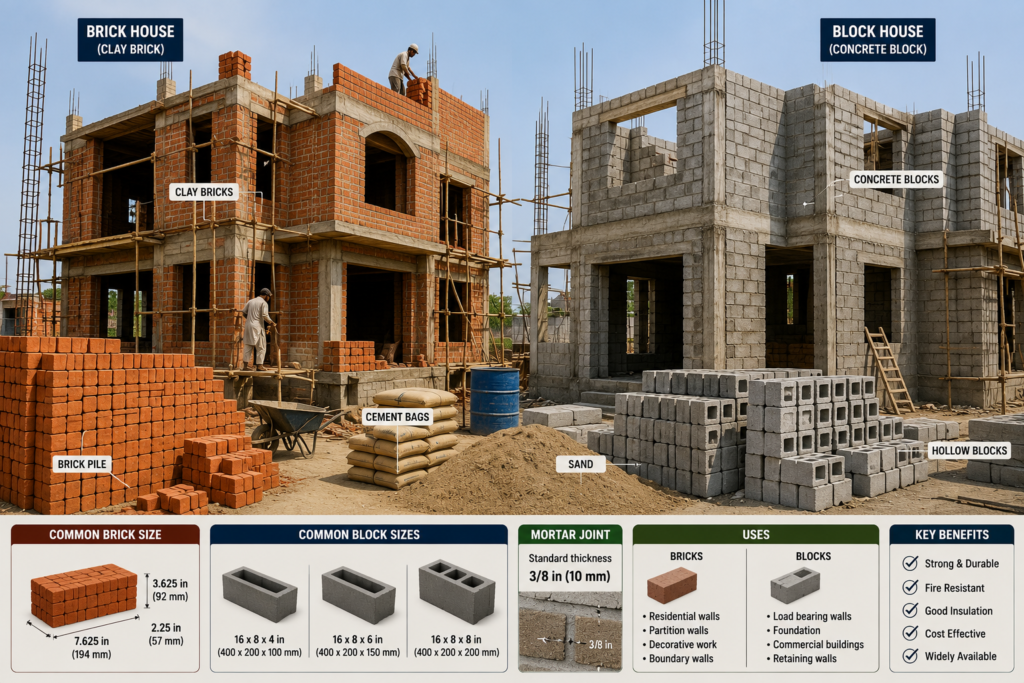
Although brick sizes vary worldwide, one of the most commonly used modular brick sizes is shown below.
| Unit | Standard Size |
|---|---|
| Inches | 7.625 × 3.625 × 2.25 in |
| Millimeters | 194 × 92 × 57 mm |
| Centimeters | 19.4 × 9.2 × 5.7 cm |
When a standard 3/8-inch mortar joint is added, the nominal brick size becomes approximately:
| Nominal Size | Measurement |
|---|---|
| Inches | 8 × 4 × 2.67 in |
| Millimeters | 203 × 102 × 68 mm |
Nominal dimensions help builders calculate wall layouts more accurately.Need help converting brick dimensions?
Brick and block dimensions may be listed in inches in some markets, so our Inch Measurement guide can help you understand these measurements.
Brick Size Conversion Chart
The following table converts common brick measurements into multiple units.
| Measurement | Inches | Centimeters | Millimeters |
|---|---|---|---|
| Length | 7.625 | 19.4 | 194 |
| Width | 3.625 | 9.2 | 92 |
| Height | 2.25 | 5.7 | 57 |
These conversions make it easier to compare brick sizes across countries using either the Imperial or Metric measurement systems.
Common Types of Bricks
Different construction projects require different types of bricks.
Clay Bricks
Clay bricks are the most widely used building bricks for residential homes. They provide excellent durability, fire resistance, and an attractive appearance.
Common applications include:
- Exterior walls
- Interior walls
- Boundary walls
- Decorative masonry
Concrete Bricks
Concrete bricks are manufactured using cement, sand, and aggregates. They offer consistent dimensions and high compressive strength.
They are commonly used for:
- Load-bearing walls
- Garden walls
- Commercial buildings
- Landscaping projects
Engineering Bricks
Engineering bricks are designed for maximum strength and low water absorption.
Typical applications include:
- Foundations
- Retaining walls
- Bridges
- Underground structures
Facing Bricks
Facing bricks are manufactured with appearance in mind. They are available in different colors, textures, and finishes to improve a building’s exterior.
They are often chosen for:
- House facades
- Decorative walls
- Architectural features
Fire Bricks
Fire bricks, also called refractory bricks, are specially designed to withstand extremely high temperatures.
Common uses include:
- Fireplaces
- Kilns
- Furnaces
- Pizza ovens
- Industrial chimneys
Modular vs Non-Modular Bricks
Builders often choose between modular and non-modular bricks depending on project requirements.
| Feature | Modular Brick | Non-Modular Brick |
|---|---|---|
| Standardized Size | Yes | Varies |
| Construction Speed | Faster | Slower |
| Material Waste | Lower | Higher |
| Mortar Alignment | Easier | Less consistent |
| Best For | Modern construction | Custom projects |
Modular bricks are generally preferred because they simplify planning and improve construction efficiency.
Convert bathroom measurements accurately using this simple Millimetre to centimetre conversion guide.
Choosing the Right Brick Size
When selecting bricks for a project, consider several factors:
- Structural requirements
- Wall thickness
- Local building codes
- Climate conditions
- Material availability
- Construction budget
- Desired appearance
Choosing the correct brick dimensions helps improve strength, reduce waste, and create a more uniform finished structure.
Standard Concrete Block Dimensions
Concrete blocks, also known as Concrete Masonry Units (CMUs), are larger than bricks and are commonly used for structural walls, foundations, and commercial buildings.
Standard Concrete Block Sizes
| Size | Inches | Millimeters |
|---|---|---|
| Half Block | 8 × 8 × 8 | 200 × 200 × 200 |
| Standard Block | 16 × 8 × 8 | 400 × 200 × 200 |
| Flat Block | 16 × 8 × 4 | 400 × 200 × 100 |
Note: The actual size is usually about 3/8 inch smaller to allow space for mortar joints.
Hollow Block Dimensions
Hollow concrete blocks contain internal cavities that reduce weight while maintaining strength.
Common Hollow Block Sizes
| Inches | Millimeters |
|---|---|
| 16 × 8 × 4 | 400 × 200 × 100 |
| 16 × 8 × 6 | 400 × 200 × 150 |
| 16 × 8 × 8 | 400 × 200 × 200 |
| 16 × 8 × 12 | 400 × 200 × 300 |
Common Uses
- Boundary walls
- Residential houses
- Commercial buildings
- Partition walls
Solid Concrete Block Dimensions
Solid concrete blocks contain little or no hollow space, making them stronger and more durable.
Standard Sizes
| Inches | Millimeters |
|---|---|
| 16 × 8 × 4 | 400 × 200 × 100 |
| 16 × 8 × 6 | 400 × 200 × 150 |
| 16 × 8 × 8 | 400 × 200 × 200 |
Common Uses
- Load-bearing walls
- Foundations
- Retaining walls
- Industrial buildings
Brick vs Block Dimensions
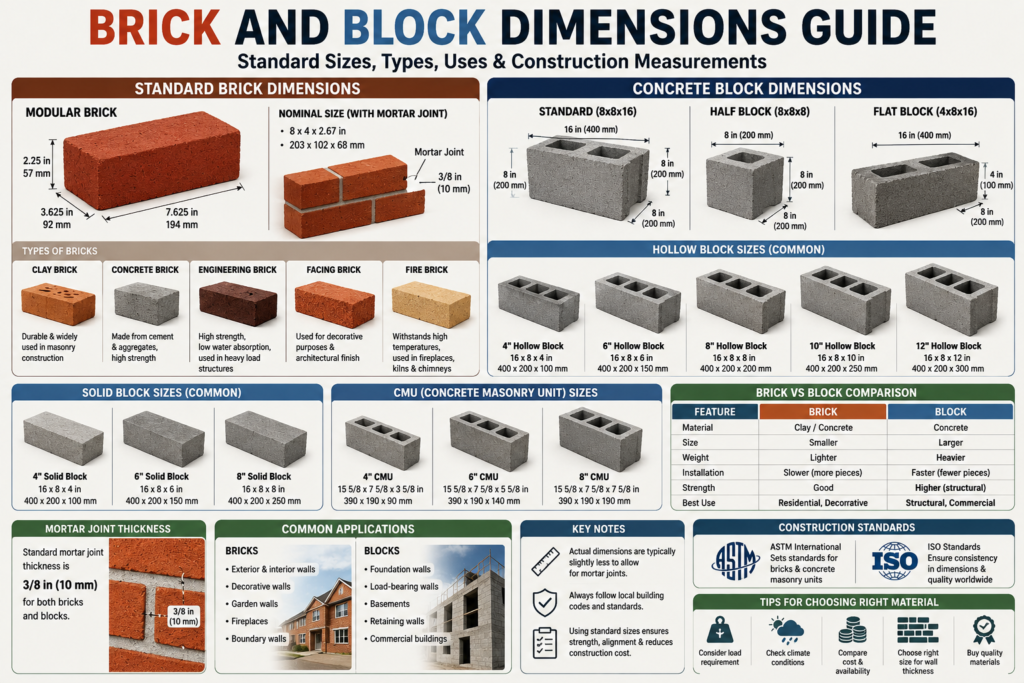
Although both are masonry materials, they differ in size, weight, and application.
| Feature | Brick | Concrete Block |
|---|---|---|
| Material | Clay or Concrete | Concrete |
| Size | Smaller | Larger |
| Weight | Lighter | Heavier |
| Installation | More pieces required | Faster installation |
| Best For | Houses & decorative walls | Structural and commercial projects |
Blocks are generally preferred for faster construction, while bricks offer a more traditional appearance.
Standard building dimensions are also important when planning spaces, and our Public Bathroom and Toilet Dimensions guide explains common measurements.
Standard Mortar Joint Thickness
Mortar joints are the spaces between bricks or blocks filled with mortar.
The most common thickness is:
- 3/8 inch (10 mm)
A consistent mortar joint improves wall alignment, strength, and appearance.
Construction Standards
Manufacturers follow recognized standards to ensure consistent dimensions and quality.
Some widely used standards include:
- ASTM International – Defines specifications for bricks and concrete masonry units.
- ISO Standards – Promote uniform measurement practices worldwide.
- Local Building Codes – May specify approved brick and block sizes for residential and commercial construction.
Following these standards helps improve safety, durability, and compatibility between building materials.
Common Applications of Bricks and Blocks
Both bricks and blocks are used in a wide range of construction projects.
Bricks
- House exteriors
- Interior walls
- Garden walls
- Fireplaces
- Decorative facades
Concrete Blocks
- Foundation walls
- Basements
- Garages
- Schools
- Warehouses
- Commercial buildings
Choosing the right material depends on the project’s structural needs, budget, and desired appearance.
Tips for Choosing the Right Brick or Block
Before purchasing construction materials, consider these factors:
- Choose bricks for decorative finishes and residential projects.
- Use concrete blocks for faster construction and stronger structural walls.
- Verify dimensions before ordering to avoid installation issues.
- Select materials that meet local building codes.
- Estimate the required quantity, including mortar joints, to minimize waste.
Quick Brick and Block Size Reference Chart
The table below summarizes some of the most common brick and block dimensions used in construction.
| Material | Standard Size (Inches) | Standard Size (mm) |
|---|---|---|
| Modular Brick | 7.625 × 3.625 × 2.25 | 194 × 92 × 57 |
| Nominal Brick | 8 × 4 × 2.67 | 203 × 102 × 68 |
| Concrete Block | 16 × 8 × 8 | 400 × 200 × 200 |
| Hollow Block | 16 × 8 × 8 | 400 × 200 × 200 |
| Solid Block | 16 × 8 × 6 | 400 × 200 × 150 |
This chart provides a quick reference when selecting building materials for residential or commercial projects.
Bricks and blocks are only one part of construction, while structural materials such as steel beams also come in standardized sizes
Common Mistakes to Avoid
Using the correct brick or block size is essential for a successful construction project. Avoid these common mistakes:
- Ignoring mortar joint thickness during measurements.
- Mixing different brick or block sizes in the same wall.
- Ordering materials without calculating waste.
- Choosing blocks that don’t meet structural requirements.
- Failing to follow local building codes and standards.
Planning your measurements carefully can save both time and construction costs.
Conclusion
Understanding Brick and Block Dimensions helps builders, contractors, and homeowners make informed construction decisions. Whether you’re using standard clay bricks or concrete blocks, selecting the correct dimensions improves structural strength, simplifies installation, and reduces material waste.
By using standard size charts and following recognized construction practices, you can estimate materials more accurately and complete projects with greater efficiency.
Frequently Asked Questions
1. What is the standard size of a brick?
A standard modular brick typically measures 7.625 × 3.625 × 2.25 inches (194 × 92 × 57 mm).
2. What is the standard size of a concrete block?
The most common concrete block size is 16 × 8 × 8 inches (400 × 200 × 200 mm).
3. What is the difference between a brick and a block?
Bricks are generally smaller and often made from clay, while concrete blocks are larger, heavier, and commonly used for structural walls.
4. What is the standard mortar joint thickness?
The recommended mortar joint thickness is 3/8 inch (10 mm)
5. Are brick sizes the same in every country?
No. Brick dimensions can vary depending on local building standards and manufacturers, although many follow internationally recognized guidelines.
6. Which is stronger: bricks or concrete blocks?
Concrete blocks generally provide greater structural strength for large buildings, while bricks are preferred for residential construction and decorative finishes.
7. Why are concrete blocks larger than bricks?
Larger blocks cover more wall area, reducing construction time, labor, and the amount of mortar required.
8. How do I choose the right brick or block size?
Consider your project’s structural requirements, local building codes, wall thickness, budget, and the appearance you want to achieve.