
Steel Beam Sizes According to New Zealand, Australia, United States, Pakistan, Europe & India
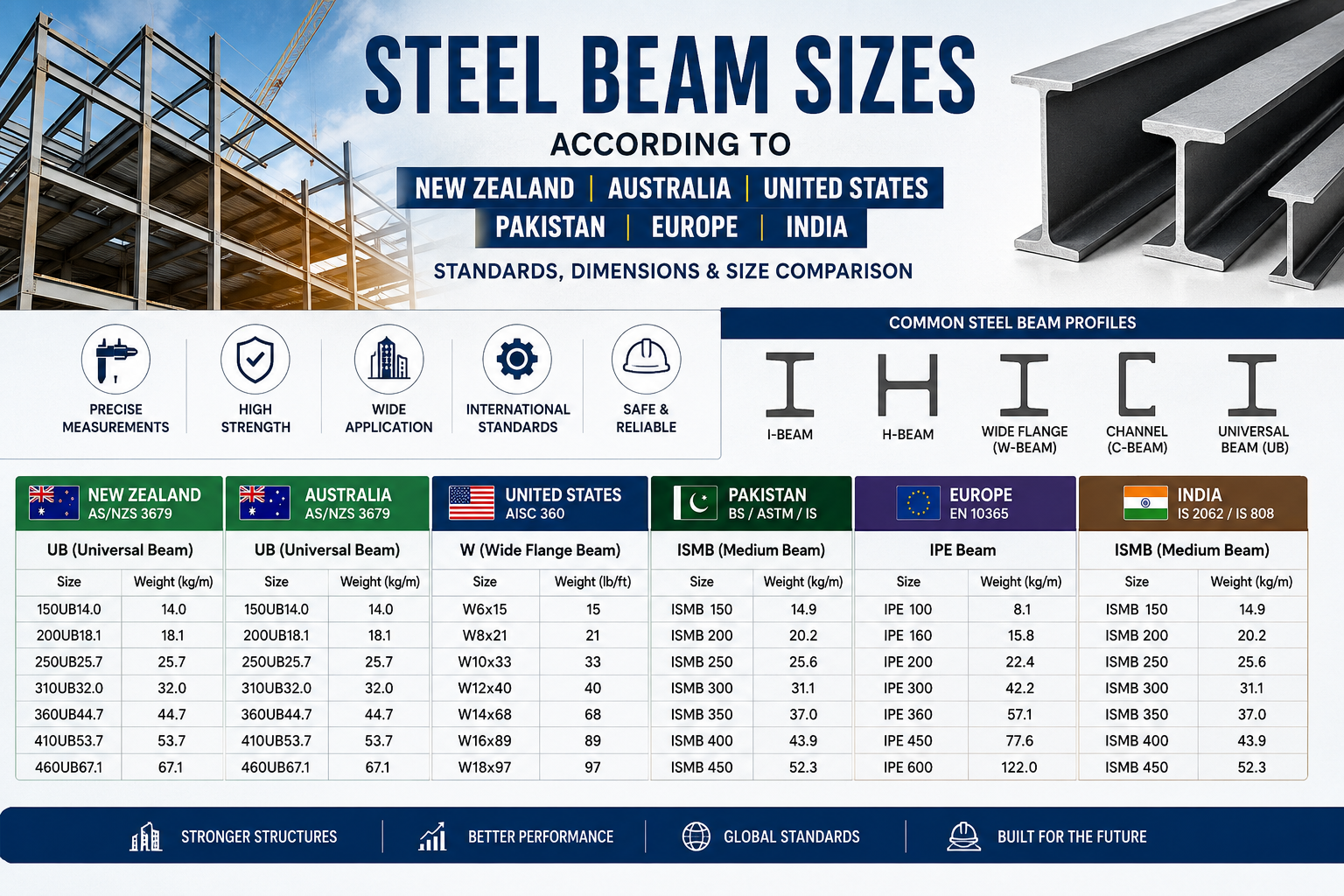
Steel beams are among the most important structural components used in modern construction. Whether you’re building a residential house, commercial complex, industrial warehouse, bridge, or multi-story building, choosing the correct steel beam sizes according to New Zealand, Australia, United States, Pakistan, Europe, and India is essential for structural strength, safety, and long-term performance.
Different countries follow different engineering standards and naming systems. For example, engineers in the United States commonly specify W-Beams (Wide Flange Beams), while Europe primarily uses IPE, HEA, HEB, and HEM sections. Australia and New Zealand follow AS/NZS structural steel standards, whereas India and Pakistan generally use ISMB, ISWB, UB, UC, and locally manufactured rolled steel sections.
Understanding these differences helps architects, engineers, contractors, students, and material suppliers communicate effectively, select compatible materials, and comply with local building codes.
In this guide, you’ll learn how steel beam sizes vary across different countries, the standards behind each sizing system, how measurements are expressed, and what to consider when selecting the right beam for your project.
What Is a Steel Beam?
A steel beam is a horizontal or inclined structural member designed to carry loads from floors, roofs, walls, or other structural elements and safely transfer those loads to columns or foundations.
Steel beams are manufactured from structural steel and are valued for their:
- High strength-to-weight ratio
- Excellent load-bearing capacity
- Long service life
- Fire resistance when properly protected
- Fast construction and installation
- Recyclability and sustainability
Steel beams are used in nearly every type of construction, including:
- Residential homes
- High-rise buildings
- Shopping malls
- Factories
- Airports
- Schools
- Hospitals
- Bridges
- Industrial plants
- Warehouses
Why Steel Beam Sizes Differ Between Countries
Although steel behaves the same everywhere, each country has developed its own manufacturing standards and design codes over decades.
Several factors influence these differences:
- National engineering standards
- Historical manufacturing practices
- Preferred unit systems (Metric vs Imperial)
- Local construction methods
- Available rolling mills
- Building regulations
- Design philosophies
- Market demand
For example:
| Country | Common Measurement System | Typical Beam Series |
|---|---|---|
| United States | Inches | W, S, HP, M |
| Europe | Millimeters | IPE, HEA, HEB, HEM |
| Australia | Metric | UB, UC, PFC |
| New Zealand | Metric | UB, UC |
| India | Metric | ISMB, ISWB, ISHB |
| Pakistan | Metric | ISMB, UB, UC, Local Sections |
Because of these differences, a beam specified in one country may not have an exact equivalent in another. Engineers often compare properties such as section modulus, moment of inertia, depth, flange width, and weight instead of relying solely on beam names.
Understand inches, centimeters, millimeters, and other everyday measurement conversions.
Understanding Steel Beam Measurements
Before comparing international beam sizes, it’s important to understand the basic dimensions that define a steel beam.
Beam Depth
Beam depth is the vertical height from the top flange to the bottom flange.
Generally:
- Greater depth increases bending strength.
- Deeper beams reduce deflection over long spans.
- Larger buildings typically require deeper beams.
Flange Width
The flange is the horizontal portion at the top and bottom of the beam.
A wider flange provides:
- Better load distribution
- Improved lateral stability
- Greater resistance to bending
Wide-flange beams are widely used in commercial and industrial construction.
Web Thickness
The web is the vertical section connecting the flanges.
Its main function is to resist shear forces generated by applied loads.
Flange Thickness
Thicker flanges increase the beam’s overall strength and improve its resistance to heavy loads.
Beam Weight
Steel beams are usually classified by their weight per unit length.
Examples include:
- Pounds per foot (lb/ft) in the United States
- Kilograms per meter (kg/m) in Europe, Australia, New Zealand, Pakistan, and India
Heavier beams generally provide greater structural capacity but also increase transportation and installation costs.
Common Types of Steel Beams
Different beam profiles are designed for specific structural applications.
Wide Flange Beam (W Beam)
Also called an H-beam in many regions, the wide flange beam is one of the most widely used structural sections.
Applications include:
- Commercial buildings
- Warehouses
- Industrial plants
- Bridges
- Multi-story structures
Advantages:
- Excellent load capacity
- High bending resistance
- Efficient structural performance
- Easy connection with columns
Universal Beam (UB)
Universal Beams are commonly used in Australia, New Zealand, and several Commonwealth countries.
Typical uses include:
- Office buildings
- Residential construction
- Industrial frames
- Steel sheds
They offer an excellent balance between strength and weight.
Universal Column (UC)
Universal Columns have wider flanges and are primarily designed for vertical load-bearing applications.
They are commonly used in:
- Building columns
- Portal frames
- Industrial structures
- High-rise construction
I-Beam
The traditional I-Beam has narrower flanges than a wide flange beam.
It is suitable for:
- Smaller buildings
- Roof framing
- Floor supports
- Machinery platforms
H-Beam
H-Beams feature wider flanges and thicker sections than conventional I-beams.
They are preferred for:
- Heavy industrial buildings
- Bridges
- Large-span structures
- High-load applications
Parallel Flange Channel (PFC)
PFC sections are channel-shaped structural members used in:
- Secondary framing
- Equipment supports
- Staircases
- Structural bracing
Steel Beam Naming Systems Around the World
One of the biggest challenges for engineers working internationally is understanding different beam designations.
Steel beam specifications are often provided in millimeters, so our Millimeter to Centimeter Conversion guide can help you convert these measurements easily.
United States
The American steel industry primarily uses:
- W (Wide Flange)
- S (American Standard Beam)
- HP (Bearing Piles)
- M Sections
Example:
W12×40
This means:
- Approximate beam depth: 12 inches
- Weight: 40 pounds per foot
Europe
European structural sections commonly include:
- IPE
- IPN
- HEA
- HEB
- HEM
Example:
IPE 300
The number approximately represents the beam depth in millimeters.
Australia & New Zealand
Australia and New Zealand typically use:
- UB (Universal Beam)
- UC (Universal Column)
- PFC (Parallel Flange Channel)
Example:
310UB40.4
This designation indicates:
- Approximate depth: 310 mm
- Universal Beam series
- Weight: 40.4 kg/m
India
India follows structural steel designations such as:
- ISMB (Indian Standard Medium Weight Beam)
- ISWB (Indian Standard Wide Flange Beam)
- ISHB (Indian Standard Heavy Beam)
Example:
ISMB 300
The beam has an approximate depth of 300 mm and complies with Indian Standard specifications.
Steel beams are an important part of structural construction, just like the standard brick and block sizes covered in our Brick and Block Dimensions guide
Pakistan
Pakistan commonly uses:
- ISMB sections
- UB sections
- UC sections
- Imported European sections
- Locally manufactured rolled steel beams
Large infrastructure and commercial projects often specify international beam profiles based on project requirements, consultant preferences, or imported structural steel.
Why Engineers Use Standard Beam Sizes
Using standardized beam sizes offers several important benefits:
- Ensures structural safety
- Simplifies engineering calculations
- Reduces fabrication errors
- Improves compatibility with design software
- Supports compliance with national building codes
- Makes sourcing and replacement easier
- Reduces construction costs
- Improves quality control
As a result, standardized beam sections have become the foundation of modern steel construction worldwide.
Steel Beam Sizes According to New Zealand, Australia, United States, Pakistan, Europe & India
Selecting the correct steel beam size depends on much more than the beam’s depth. Structural engineers evaluate the expected loads, span length, support conditions, deflection limits, and applicable building codes before specifying a beam. While the naming systems differ from country to country, the underlying engineering principles remain the same.
Below is a detailed comparison of the most common beam sizes and standards used around the world.
Steel Beam Sizes in New Zealand
New Zealand primarily follows the AS/NZS structural steel standards, which are closely aligned with Australian specifications. Universal Beams (UB) and Universal Columns (UC) are the most commonly used sections in residential, commercial, and industrial construction.
Common New Zealand Universal Beam Sizes
| Beam Designation | Approx. Depth (mm) | Weight (kg/m) | Typical Applications |
|---|---|---|---|
| 150UB14.0 | 150 | 14.0 | House lintels, small sheds |
| 180UB18.1 | 180 | 18.1 | Residential floors |
| 200UB22.3 | 200 | 22.3 | Small commercial buildings |
| 250UB31.4 | 250 | 31.4 | Warehouses |
| 310UB40.4 | 310 | 40.4 | Multi-story buildings |
| 360UB44.7 | 360 | 44.7 | Industrial construction |
| 410UB59.7 | 410 | 59.7 | Heavy structural frames |
| 460UB67.1 | 460 | 67.1 | Large-span buildings |
| 530UB82 | 530 | 82 | Bridges and factories |
| 610UB101 | 610 | 101 | Heavy engineering projects |
Common Uses
- Residential homes
- Office buildings
- Distribution warehouses
- Industrial plants
- Agricultural buildings
- Infrastructure projects
Steel Beam Sizes in Australia
Australia uses nearly the same beam designation system as New Zealand because both countries adopt AS/NZS structural steel standards.
Popular Australian Universal Beam Sizes
| Beam | Depth (mm) | Weight (kg/m) |
|---|---|---|
| 150UB14.0 | 150 | 14.0 |
| 180UB18.1 | 180 | 18.1 |
| 200UB25.4 | 200 | 25.4 |
| 250UB31.4 | 250 | 31.4 |
| 310UB40.4 | 310 | 40.4 |
| 360UB50.7 | 360 | 50.7 |
| 410UB53.7 | 410 | 53.7 |
| 460UB67.1 | 460 | 67.1 |
| 530UB92.4 | 530 | 92.4 |
| 610UB125 | 610 | 125 |
Where They’re Used
- Shopping centers
- Apartment buildings
- Factories
- Schools
- Hospitals
- Steel portal frames
- Mining facilities
Why UB Sections Are Popular
Universal Beams provide:
- High bending resistance
- Efficient weight distribution
- Excellent structural stability
- Wide availability
- Compatibility with modern design software
Steel Beam Sizes in the United States
The United States follows standards developed by the American Institute of Steel Construction (AISC). Wide Flange (W) beams dominate the American structural steel market.
Unlike metric systems, American beam names are based on:
- Approximate beam depth (inches)
- Weight (pounds per foot)
Example:
W12×40
- Approximately 12 inches deep
- Weighs 40 lb/ft
Common American Wide Flange Beam Sizes
| Beam | Approx. Depth (in) | Weight (lb/ft) | Typical Use |
|---|---|---|---|
| W4×13 | 4 | 13 | Residential framing |
| W6×15 | 6 | 15 | Small buildings |
| W8×21 | 8 | 21 | Floor framing |
| W10×33 | 10 | 33 | Commercial structures |
| W12×40 | 12 | 40 | Multi-story buildings |
| W14×68 | 14 | 68 | Office buildings |
| W16×89 | 16 | 89 | Industrial facilities |
| W18×97 | 18 | 97 | Bridges |
| W21×111 | 21 | 111 | Heavy construction |
| W24×162 | 24 | 162 | Large-span structures |
Advantages of Wide Flange Beams
- Greater load capacity
- Better flange stability
- Easier bolted and welded connections
- Ideal for long-span construction
Steel Beam Sizes in Europe
European countries use standardized steel sections based on metric dimensions. The most common beam series include:
- IPE
- IPN
- HEA
- HEB
- HEM
Each profile is designed for different structural requirements.
Construction projects also require accurate space planning, including the standard measurements discussed in our Public Bathroom and Toilet Dimensions guide.
Common European IPE Beam Sizes
| Beam | Depth (mm) | Weight (kg/m) |
|---|---|---|
| IPE 100 | 100 | 8.1 |
| IPE 160 | 160 | 15.8 |
| IPE 200 | 200 | 22.4 |
| IPE 240 | 240 | 30.7 |
| IPE 300 | 300 | 42.2 |
| IPE 360 | 360 | 57.1 |
| IPE 450 | 450 | 77.6 |
| IPE 600 | 600 | 122 |
HEA Beam Sizes
HEA beams are lightweight wide-flange sections commonly used in commercial buildings.
Popular sizes include:
- HEA100
- HEA160
- HEA200
- HEA240
- HEA300
- HEA400
HEB Beam Sizes
HEB sections feature thicker flanges and greater strength.
They are suitable for:
- Bridges
- Industrial plants
- High-rise buildings
- Heavy machinery supports
HEM Beam Sizes
HEM beams are the heaviest members in the European H-section family.
Typical applications include:
- Offshore structures
- Heavy cranes
- Steel mills
- Large industrial facilities
Steel Beam Sizes in India
India follows standards issued by the Bureau of Indian Standards (BIS). Engineers commonly specify ISMB, ISWB, and ISHB sections.
Common ISMB Sizes
| Beam | Approx. Depth (mm) | Weight (kg/m) |
|---|---|---|
| ISMB100 | 100 | 11.5 |
| ISMB150 | 150 | 14.9 |
| ISMB200 | 200 | 35.4 |
| ISMB250 | 250 | 37.3 |
| ISMB300 | 300 | 44.2 |
| ISMB350 | 350 | 52.4 |
| ISMB400 | 400 | 61.6 |
| ISMB450 | 450 | 72.4 |
| ISMB500 | 500 | 86.9 |
| ISMB600 | 600 | 122.6 |
Common Applications
- Residential buildings
- Highway bridges
- Railway stations
- Industrial sheds
- Manufacturing plants
- Educational institutions
Steel Beam Sizes in Pakistan
Pakistan uses a combination of locally manufactured and imported structural steel sections. Many projects adopt beam sizes compatible with Indian, British, Australian, or European standards depending on design requirements and material availability.
Common beam categories include:
- Universal Beams (UB)
- Universal Columns (UC)
- ISMB sections
- Wide Flange beams
- European IPE sections
Common Steel Beam Sizes Used in Pakistan
| Beam Type | Approx. Depth |
|---|---|
| ISMB150 | 150 mm |
| ISMB200 | 200 mm |
| ISMB250 | 250 mm |
| ISMB300 | 300 mm |
| ISMB350 | 350 mm |
| ISMB400 | 400 mm |
| ISMB450 | 450 mm |
| UB310 | 310 mm |
| UB410 | 410 mm |
| IPE300 | 300 mm |
Typical Applications
- Residential houses
- Commercial plazas
- Industrial warehouses
- Textile mills
- Cement plants
- Shopping malls
- Steel sheds
- Infrastructure projects
International Steel Beam Size Comparison
The table below highlights the primary beam systems used in each region.
| Country | Common Beam Series | Measurement Unit | Standard Practice |
|---|---|---|---|
| New Zealand | UB, UC | mm | AS/NZS |
| Australia | UB, UC, PFC | mm | AS/NZS |
| United States | W, S, HP | inches | AISC |
| Europe | IPE, HEA, HEB, HEM | mm | EN Standards |
| India | ISMB, ISWB, ISHB | mm | BIS |
| Pakistan | ISMB, UB, UC, IPE | mm | Mixed international standards |
Metric vs Imperial Beam Measurements
Understanding the unit system is essential when comparing international beam sizes.
| Metric System | Imperial System |
|---|---|
| Millimeters (mm) | Inches (in) |
| Kilograms per meter (kg/m) | Pounds per foot (lb/ft) |
| Used in Europe, Asia, Australia, NZ | Primarily used in the USA |
Quick Conversion Reference
| Measurement | Equivalent |
|---|---|
| 1 inch | 25.4 mm |
| 1 foot | 304.8 mm |
| 1 kg | 2.205 lb |
| 1 meter | 3.281 ft |
Factors That Influence Steel Beam Size Selection
Choosing the correct beam size requires evaluating several engineering factors, including:
- Span length
- Dead load
- Live load
- Wind load
- Seismic requirements
- Building occupancy
- Deflection limits
- Connection details
- Steel grade
- Local building codes
- Fabrication and transportation constraints
A beam that performs well in one project may not be suitable for another, even if the span is similar. That’s why structural calculations are essential before finalizing a beam size.
For official steel shape dimensions and structural design standards, refer to the American Institute of Steel Construction (AISC)
How to Choose the Right Steel Beam Size
Selecting the correct steel beam involves more than matching dimensions. Structural engineers typically consider:
- Span length
- Total dead and live loads
- Building type (residential, commercial, or industrial)
- Steel grade
- Local building codes
- Deflection and safety requirements
Tip: Always have a qualified structural engineer verify beam calculations before construction.
Example Applications
| Project | Common Beam Type |
|---|---|
| Residential house | ISMB 150–250, UB 150–200 |
| Small commercial building | UB 250–310, W10–W12 |
| Warehouse | UB 360–460, W14–W18 |
| Industrial plant | HEB, HEM, W21+ |
| Bridge | Heavy W, HEB, or HEM sections |
Common Mistakes to Avoid
- Choosing a beam based only on depth
- Ignoring load calculations
- Mixing international standards without checking compatibility
- Overlooking deflection limits
- Using non-certified steel sections
Frequently Asked Questions
1. Which steel beam is most commonly used worldwide?
Wide Flange (W), Universal Beam (UB), and IPE sections are among the most widely used structural beams.
2. Are steel beam sizes the same in every country?
No. Each region follows its own structural standards and naming conventions.
3. What does W12×40 mean?
It refers to a Wide Flange beam that is approximately 12 inches deep and weighs 40 pounds per foot.
4. Which beam types are common in Europe?
Europe mainly uses IPE, HEA, HEB, and HEM beam sections.
5. What beam standards are used in Pakistan?
Pakistan commonly uses ISMB, UB, UC, and imported European IPE sections, depending on the project.
6. Can I substitute one country’s beam with another’s?
Only after confirming equivalent structural properties such as strength, section modulus, and moment of inertia.
Conclusion
Understanding Steel Beam Sizes according to New Zealand, Australia, United States, Pakistan, Europe & India helps engineers, contractors, and builders select the right structural members for safe and efficient construction. Although each country uses different standards and naming systems, the goal remains the same: providing reliable load-bearing performance that complies with local building regulations. Always verify beam selection through structural calculations and applicable national standards before beginning any project.