Playing Card Dimensions: Standard Size Guide (Inches, CM & MM)
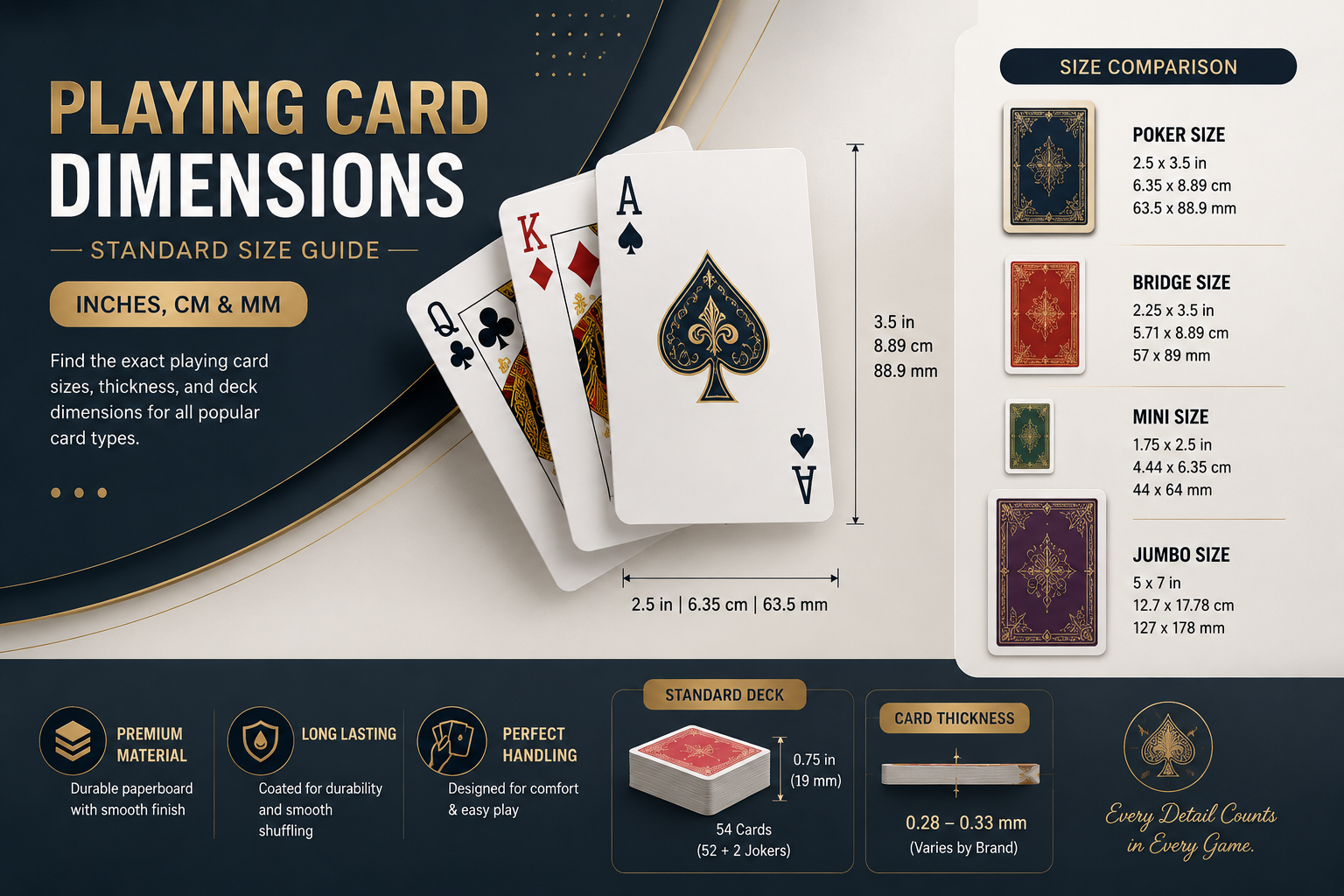
Understanding playing card dimensions is important whether you’re buying a new deck, designing custom cards, printing game cards, or collecting premium decks. While most playing cards look similar, they come in different sizes depending on their purpose. Poker cards, bridge cards, and specialty cards each have slightly different measurements.
In this guide, you’ll learn the standard playing card dimensions in inches, centimeters, and millimeters, compare the most common card sizes, and discover how to choose the right dimensions for your needs.
What Are the Standard Playing Card Dimensions?
The most common playing card used around the world is the Poker Size card.
| Unit | Standard Poker Card Size |
|---|---|
| Inches | 2.5 × 3.5 in |
| Centimeters | 6.35 × 8.89 cm |
| Millimeters | 63.5 × 88.9 mm |
These dimensions are widely used by casinos, home card games, and custom card manufacturers.
Playing Card Dimensions Conversion Chart
| Unit | Width | Height |
|---|---|---|
| Inches | 2.5 | 3.5 |
| Centimeters | 6.35 | 8.89 |
| Millimeters | 63.5 | 88.9 |
This chart makes it easy to compare measurements across different unit systems.
Why Do Playing Card Dimensions Matter?
Card size affects both gameplay and handling. Choosing the correct dimensions can improve comfort, durability, and the overall playing experience.
Standard dimensions are important for:
- Card games
- Casino decks
- Custom printing
- Magic tricks
- Cardistry
- Collecting
- Storage boxes and card sleeves
Using the correct size also ensures compatibility with accessories like deck boxes and protective sleeves.
Learn how to convert inches into centimeters, millimeters, and other common measurement units.
Types of Playing Card Sizes
Although poker cards are the most popular, several other sizes are commonly used.
Poker Size Cards
Poker cards are the industry standard and are suitable for most games.
Dimensions
- 2.5 × 3.5 inches
- 63.5 × 88.9 mm
Common uses include:
- Poker
- Blackjack
- Texas Hold’em
- Solitaire
- Magic tricks
Bridge Size Cards
Bridge cards are slightly narrower, making them easier to hold when players have many cards.
| Measurement | Size |
|---|---|
| Inches | 2.25 × 3.5 |
| Millimeters | 57 × 89 mm |
They are commonly used for:
- Bridge
- Rummy
- Canasta
- Other card games requiring larger hands
Mini Playing Cards
Mini cards are smaller than standard decks and are often chosen for travel or novelty purposes.
Typical dimensions include:
- 1.75 × 2.5 inches
- 44 × 64 mm
These cards fit easily into pockets and travel kits.
Jumbo Playing Cards
Jumbo cards feature oversized faces that are easier to read from a distance.
Typical size:
- Approximately 5 × 7 inches
They are commonly used for:
- Classroom activities
- Party games
- Demonstrations
- Magic performances
Poker Cards vs Bridge Cards
Although they share the same height, poker and bridge cards differ in width.
| Feature | Poker Cards | Bridge Cards |
|---|---|---|
| Width | 2.5 in | 2.25 in |
| Height | 3.5 in | 3.5 in |
| Easier to Hold | No | Yes |
| Best For | Poker & Casinos | Bridge & Rummy |
Poker cards provide a larger surface for artwork, while bridge cards are preferred by players who need to hold many cards comfortably.
Learn how to convert millimetres to centimetres using simple formulas and conversion charts.
Common Playing Card Dimensions at a Glance
| Card Type | Inches | Millimeters |
|---|---|---|
| Poker | 2.5 × 3.5 | 63.5 × 88.9 |
| Bridge | 2.25 × 3.5 | 57 × 89 |
| Mini | 1.75 × 2.5 | 44 × 64 |
| Jumbo | 5 × 7 (approx.) | 127 × 178 |
These are the most widely recognized playing card sizes used across different games and industries.
Playing Card Thickness and Material
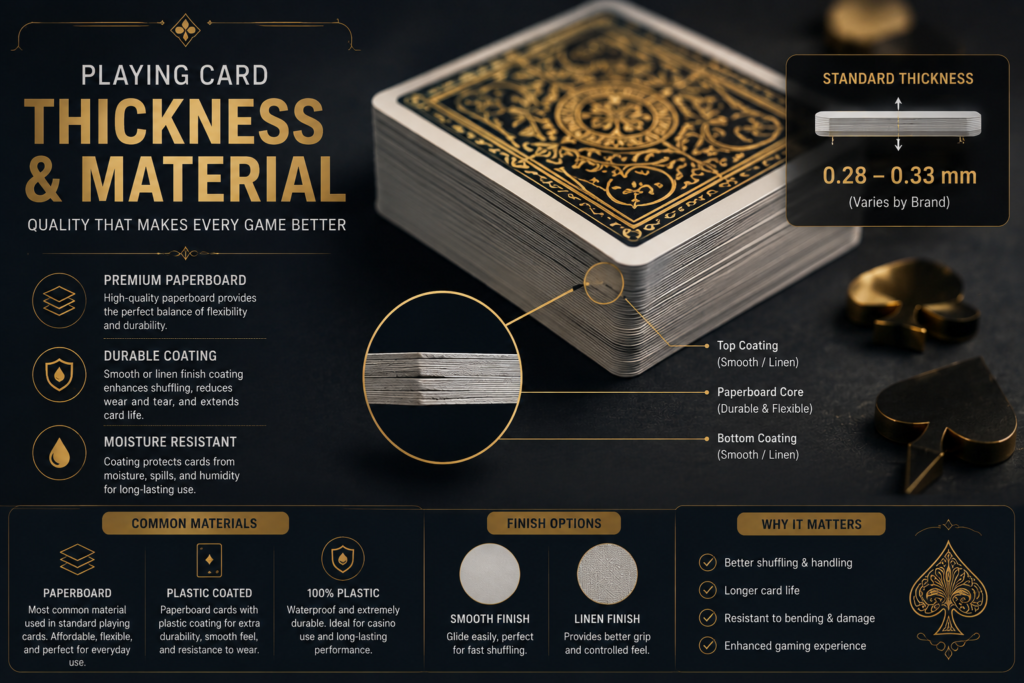
Besides playing card dimensions, thickness and material also affect durability and handling. Most standard playing cards are made from paperboard with a plastic or linen finish for a smooth shuffle.
| Feature | Standard Measurement |
|---|---|
| Thickness | 0.28–0.33 mm |
| Material | Paperboard with coating |
| Finish | Smooth or Linen |
Premium cards often use plastic-coated or 100% plastic material, making them more durable and water-resistant.
Standard Deck Dimensions
A standard deck contains 52 playing cards plus 2 Jokers, for a total of 54 cards.
Approximate deck size:
| Unit | Dimensions |
|---|---|
| Inches | 2.5 × 3.5 × 0.75 in |
| Millimeters | 63.5 × 88.9 × 19 mm |
The exact thickness may vary depending on the card stock and manufacturer.
Other printed products also use standardized dimensions, such as the flyer sizes explained in our complete printing guide
Common Uses of Playing Cards
Standard playing card dimensions are used in many activities, including:
- Poker and Blackjack
- Bridge and Rummy
- Magic tricks
- Cardistry
- Board games
- Custom promotional cards
- Educational flashcards
Their universal size also makes it easy to find matching sleeves and storage boxes.
How to Choose the Right Playing Card Size
Choose your cards based on how you plan to use them.
- Poker Size: Best for casinos, home games, and cardistry.
- Bridge Size: Easier to hold for games with larger hands.
- Mini Cards: Great for travel and portable games.
- Jumbo Cards: Ideal for teaching, parties, and stage performances.
Selecting the right size improves comfort, gameplay, and storage.
Compare A4, A5, A6, B5, and Letter Notebook sizes with detailed measurements.
Playing Card Size Comparison
| Card Type | Size (Inches) | Best For |
|---|---|---|
| Poker | 2.5 × 3.5 | Poker, Blackjack |
| Bridge | 2.25 × 3.5 | Bridge, Rummy |
| Mini | 1.75 × 2.5 | Travel Games |
| Jumbo | 5 × 7 | Demonstrations |
Quick Tips
- Use Poker Size for most standard card games.
- Choose Bridge Size if you prefer narrower cards.
- Buy quality card sleeves to protect your deck.
- Plastic-coated cards last longer than standard paper cards.
Conclusion
Understanding playing card dimensions helps you choose the right deck for gaming, collecting, custom printing, or magic tricks. While the standard Poker Size card measures 2.5 × 3.5 inches (63.5 × 88.9 mm), other sizes like Bridge, Mini, and Jumbo cards are designed for specific purposes. Knowing these measurements ensures better compatibility with card sleeves, storage boxes, and accessories.Whether you’re a casual player or a professional, using the correct playing card size improves comfort, handling, and overall gameplay.United States Playing Card Company (USPCC) – A trusted source for information about standard playing cards and card manufacturing.
Frequently Asked Questions
1. What are the standard playing card dimensions?
A standard poker playing card measures 2.5 × 3.5 inches (63.5 × 88.9 mm).
2. What is the difference between poker and bridge cards?
Poker cards are 2.5 inches wide, while bridge cards are 2.25 inches wide. Both have the same height of 3.5 inches.
3. How thick is a standard playing card?
Most playing cards are between 0.28 mm and 0.33 mm thick.
4. How many cards are in a standard deck?
A standard deck contains 52 playing cards plus 2 Jokers, making a total of 54 cards.
5. Are all playing cards the same size?
No. Common sizes include Poker, Bridge, Mini, and Jumbo cards, each designed for different uses.
6. What material are playing cards made from?
Most playing cards are made from paperboard with a plastic or linen finish. Premium decks may use 100% plastic.
7. What size sleeves fit standard playing cards?
Standard poker-size sleeves are designed for cards measuring 2.5 × 3.5 inches (63.5 × 88.9 mm).
8. Which playing card size is best?
Poker Size is the most popular choice because it is widely used for casinos, home games, and cardistry.