Tennis Racket Dimensions: Standard Sizes, Length, Width & Guide (2026)
Choosing the right tennis racket starts with understanding its dimensions. Racket length, overall width, hitting-surface size, head size, and grip dimensions can all affect how the racket feels and performs.
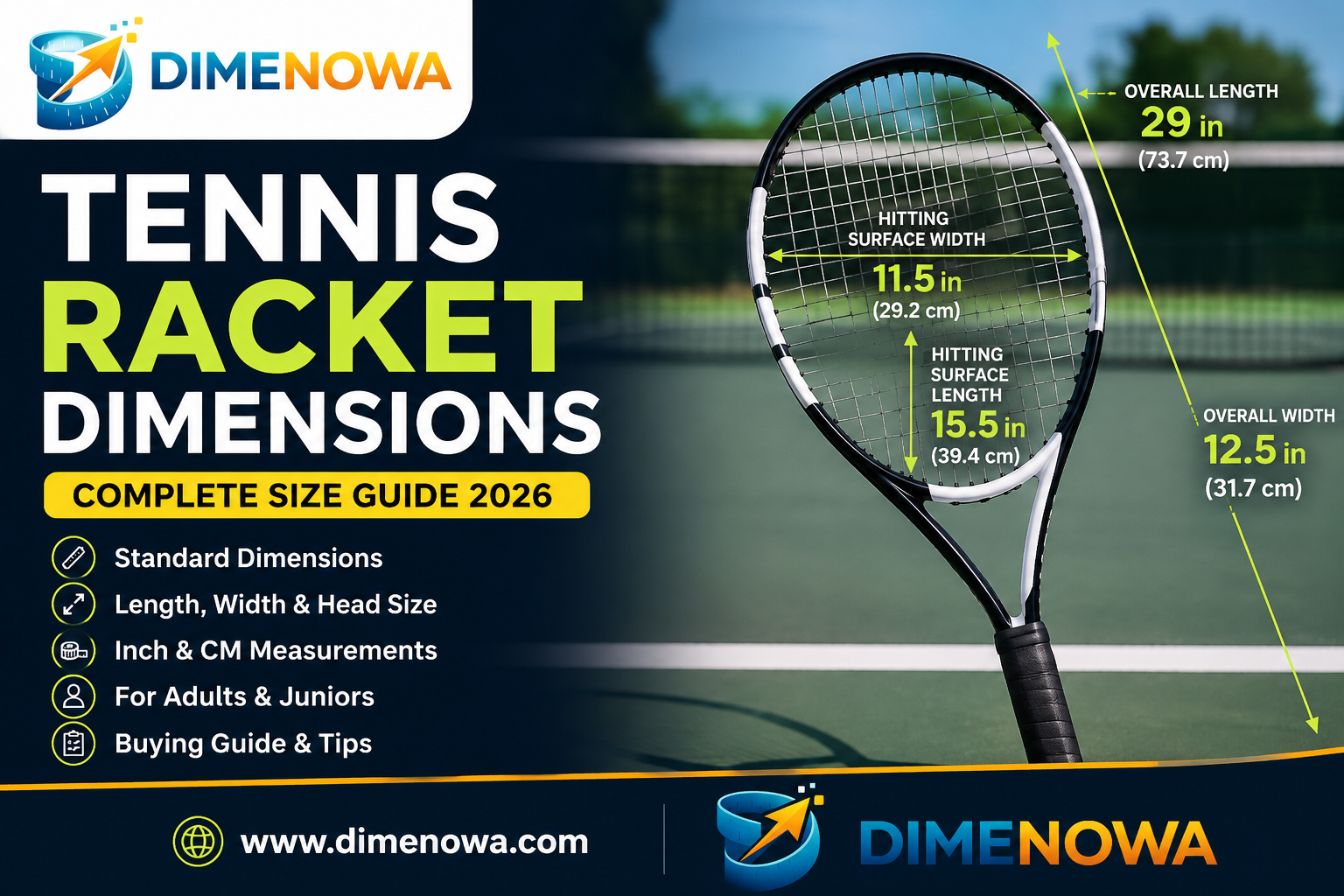
For competitive tennis, the 2026 Rules of Tennis set maximum limits for racket dimensions. A tennis racket cannot exceed 73.7 cm (29 inches) in overall length or 31.7 cm (12.5 inches) in overall width. The hitting surface cannot exceed 39.4 cm (15.5 inches) in length or 29.2 cm (11.5 inches) in width.
For most adult recreational players, a racket around 27 inches (68.6 cm) long is the common standard. Junior rackets are shorter and typically range from about 19 to 26 inches depending on the player’s age, size, and playing stage.
Quick Tennis Racket Dimensions
| Racket Measurement | Metric | Imperial |
|---|---|---|
| Maximum overall length | 73.7 cm | 29 in |
| Maximum overall width | 31.7 cm | 12.5 in |
| Maximum hitting-surface length | 39.4 cm | 15.5 in |
| Maximum hitting-surface width | 29.2 cm | 11.5 in |
| Common adult racket length | 68.6 cm | 27 in |
| Common extended adult length | Up to about 69.2 cm | About 27.25 in |
These figures describe different aspects of the racket, so the maximum overall racket dimensions should not be confused with the size of the string bed or head.
What Are the Standard Tennis Racket Dimensions?
A tennis racket consists of several main parts, including the handle, throat, head, frame, and strings. The overall length measures the racket from the butt of the handle to the farthest point of the head.
The official rules place limits on the maximum dimensions rather than requiring every racket to have exactly the same size.
According to the 2026 Rules of Tennis, the racket must not exceed 73.7 cm (29 inches) in overall length and 31.7 cm (12.5 inches) in overall width.
The hitting surface has separate limits. It cannot exceed 39.4 cm (15.5 inches) in length when measured parallel to the handle and 29.2 cm (11.5 inches) in width when measured perpendicular to the handle.
This distinction matters because a racket’s overall frame dimensions and its actual stringing area are not the same measurement.
Tennis Racket Length
Racket length is one of the easiest dimensions to understand. It is measured along the racket’s longitudinal axis, from the bottom of the handle to the top of the frame.
Standard Adult Racket Length
A 27-inch (68.6 cm) racket is the common full-size choice for adult players. Manufacturers also produce slightly longer rackets, often called extended-length rackets.
A longer racket can provide additional reach and leverage, but it may also require more control and swing speed.
“If you’re also comparing the playing area, check out our detailed guide to [Tennis Court Dimensions] for standard court measurements and sizes.”
The official competition limit is 29 inches (73.7 cm), so a racket longer than this maximum would not meet the standard racket-size requirement for play under the Rules of Tennis.
Tennis Racket Width
Overall racket width refers to the widest part of the racket head.
The 2026 Rules of Tennis specify a maximum overall width of:
31.7 cm = 12.5 inches
This is a maximum regulatory dimension, not the width of every standard adult racket.
The shape of the head varies between racket models. A wider or more rounded head can provide a different hitting area and playing feel, while narrower designs may emphasize control.
Tennis Racket Head Size
Head size is different from overall racket width.
Manufacturers usually describe head size by area, measured in square inches or square centimeters. Common adult racket head sizes include approximately:
| Head Size Category | Approx. Area | Typical Use |
|---|---|---|
| Mid | Under 95 sq in | Control-focused players |
| Midplus | 95–105 sq in | Versatile choice |
| Oversize | 106–115 sq in | Larger hitting area |
| Super oversize | 116+ sq in | Maximum forgiveness |
These categories are general equipment classifications rather than official ITF size classes.
“If you’re interested in comparing racket sports, explore our guide to [Badminton Court Dimensions] for standard court sizes, playing areas, and measurements.”
A larger head generally provides a larger string bed and a more forgiving hitting area. A smaller head can offer a more compact feel and may appeal to advanced players who prioritize precision.
Tennis Racket Hitting-Surface Dimensions
The hitting surface is the main area formed by the racket’s string pattern.
Under the 2026 Rules of Tennis, the maximum hitting-surface dimensions are:
- Length: 39.4 cm (15.5 inches)
- Width: 29.2 cm (11.5 inches)
The rules also require the hitting surface to be flat and made from a generally uniform pattern of crossed strings.
This does not mean every racket has a hitting surface of exactly 39.4 × 29.2 cm. These are maximum dimensions permitted under the rules.
Tennis Racket Dimensions in Inches
For readers who use imperial measurements, the key dimensions are:
| Measurement | Inches |
|---|---|
| Maximum overall length | 29.0 in |
| Maximum overall width | 12.5 in |
| Maximum hitting-surface length | 15.5 in |
| Maximum hitting-surface width | 11.5 in |
| Common adult length | 27.0 in |
The 27-inch adult racket is therefore noticeably shorter than the 29-inch competition maximum.
Tennis Racket Dimensions in Centimeters
The same measurements can be expressed in centimeters:
| Measurement | Centimeters |
|---|---|
| Maximum overall length | 73.7 cm |
| Maximum overall width | 31.7 cm |
| Maximum hitting-surface length | 39.4 cm |
| Maximum hitting-surface width | 29.2 cm |
| Common adult length | 68.6 cm |
These conversions use 1 inch = 2.54 cm.
Junior Tennis Racket Sizes
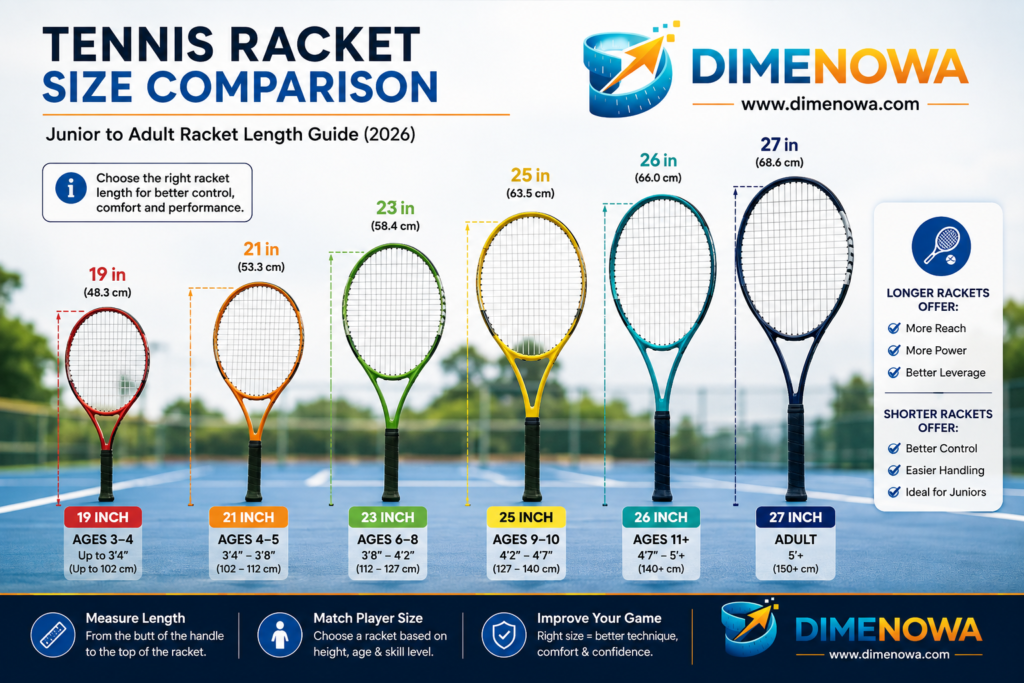
Children should not automatically use an adult racket. A shorter racket makes it easier for a young player to control the frame and develop proper technique.
The 2026 tennis competition rules for 10-and-under tennis use racket lengths matched to different stages:
| Tennis Stage | Recommended Racket Length |
|---|---|
| Stage 3 Red | Up to 23 in (58.4 cm) |
| Stage 2 Orange | 23–25 in (58.4–63.5 cm) |
| Stage 1 Green | 25–26 in (63.5–66.0 cm) |
| Full-size adult play | Commonly around 27 in (68.6 cm) |
For junior players, age and height should both be considered. Children of the same age can have significantly different body sizes, so the racket should feel manageable rather than simply matching an age chart.
“If you’re comparing different racket sports, explore our guide to [Pickleball Court Dimensions] for standard court size, layout, and playing-area measurements.
Manufacturers also produce junior rackets in sizes such as 19, 21, 23, and 25 inches.
How to Choose the Right Tennis Racket Length
The correct length depends mainly on the player’s age, height, strength, coordination, and experience.
Adults
Most adult beginners and recreational players can start with a standard 27-inch racket.
It provides a useful balance between reach, maneuverability, and control.
Teenagers
Many teenagers can transition to a full-size adult racket as their height and strength develop. However, the correct choice depends on the player’s physical development and ability to control the racket.
Young Children
Junior rackets from approximately 19 to 26 inches are commonly available. The youngest players generally need the shortest rackets, while taller and more experienced children can move toward longer frames.
A racket that feels too heavy or long can make it harder for a child to swing naturally.
How to Measure a Tennis Racket
You can measure a racket at home with a measuring tape.
Step 1: Place the Racket Upright
Put the racket vertically on a flat surface with the butt of the handle touching the surface.
Step 2: Measure the Overall Length
Measure from the bottom of the handle to the highest point of the racket head.
This gives the racket’s overall length.
Step 3: Measure the Widest Point
Measure across the widest section of the frame to determine its overall width.
Step 4: Measure the Hitting Area
If you need the string-bed dimensions, measure the stringing area rather than the outside edge of the frame.
Keep the measurements separate because overall frame size and hitting-surface size are different specifications.
Grip Size vs. Racket Size
One common mistake is confusing racket length with grip size.
Racket length describes the physical length of the frame.
Grip size describes the circumference or dimensions of the handle that the player holds.
A player can use a 27-inch racket with several different grip sizes.
When choosing a racket, consider both measurements separately.
Does Racket Size Affect Performance?
Yes. Racket dimensions can influence reach, maneuverability, power, and control.
A longer racket can provide extra reach and leverage but may require more effort to control.
A larger head can provide a larger hitting area and more forgiveness on off-center contact.
A smaller head can provide a more compact hitting area and may suit players who prioritize control.
However, dimensions are only part of a racket’s specifications. Weight, balance, beam thickness, string pattern, and stiffness can also significantly affect performance.
Common Tennis Racket Measurement Mistakes
Confusing Head Size With Racket Width
Head size is normally expressed as an area, such as square inches. Racket width is a linear measurement.
They are not interchangeable.
“For another popular racket and court sport, see our guide to [Volleyball Court Dimensions] for standard court measurements, net height, and playing-area requirements.
Assuming Every Adult Racket Is 29 Inches
The 29-inch figure is the maximum permitted overall length, not the standard length of every adult racket.
A 27-inch racket is a common adult size.
Using Adult Rackets for Small Children
Young players often benefit from shorter junior rackets that match their size and development stage.
Measuring Only the String Bed
If you want the official overall racket length, measure the entire racket, including the handle.
Ignoring Grip Size
A correctly sized racket can still feel uncomfortable if the handle grip is too large or too small.
What Is the Maximum Legal Tennis Racket Size?
Under the 2026 Rules of Tennis, the maximum overall racket length is 73.7 cm (29 inches) and the maximum overall width is 31.7 cm (12.5 inches).
The maximum hitting surface is 39.4 cm (15.5 inches) long and 29.2 cm (11.5 inches) wide.
These measurements apply to rackets approved for play under the Rules of Tennis.
Why Tennis Racket Dimensions Matter
Racket dimensions help determine how easily a player can control the equipment.
For beginners, a manageable racket can make learning easier. For experienced players, the choice often becomes more specific because they may prefer a certain combination of head size, length, weight, balance, and string pattern.
The best racket is therefore not necessarily the largest or longest one. It should match the player’s physical ability and playing style while remaining within the applicable competition rules.
Frequently Asked Questions
What is the standard tennis racket length?
A standard adult tennis racket is commonly around 27 inches (68.6 cm) long. Junior rackets are shorter, while the official maximum overall length permitted under the Rules of Tennis is 29 inches.
What is the maximum tennis racket length?
The maximum overall length is 29 inches (73.7 cm) under the 2026 Rules of Tennis.
What is the maximum tennis racket width?
The maximum overall width is 12.5 inches (31.7 cm).
What size tennis racket should an adult use?
A 27-inch racket is a common starting point for adult players. The final choice should also consider weight, head size, grip size, balance, and playing experience.
What size tennis racket is best for a child?
Junior rackets are commonly available from about 19 to 26 inches. The appropriate size depends on the child’s age, height, strength, and playing stage.
Is a 29-inch tennis racket allowed?
A racket can be up to 29 inches long under the Rules of Tennis. However, 29 inches is the maximum limit rather than the typical adult racket length.
What is the difference between racket length and head size?
Racket length is the total distance from the bottom of the handle to the top of the frame. Head size refers to the area of the racket head or string bed, normally expressed in square inches or square centimeters.
How do you measure tennis racket length?
Place the racket vertically and measure from the bottom of the handle to the highest point of the racket head. This gives the overall racket length.
Conclusion
Tennis racket dimensions vary by player type and racket design, but official competition rules establish clear maximum limits. A racket cannot exceed 29 inches (73.7 cm) in overall length or 12.5 inches (31.7 cm) in overall width. The hitting surface also has separate maximum dimensions.
For most adults, a 27-inch racket is a common full-size option, while children typically use shorter junior rackets ranging from roughly 19 to 26 inches.
Understanding racket length, width, head size, hitting-surface dimensions, and grip size makes it easier to compare rackets and choose equipment that matches the player’s needs.