Olympic Swimming Pool Dimensions: Standard Size, Depth, Lanes & More
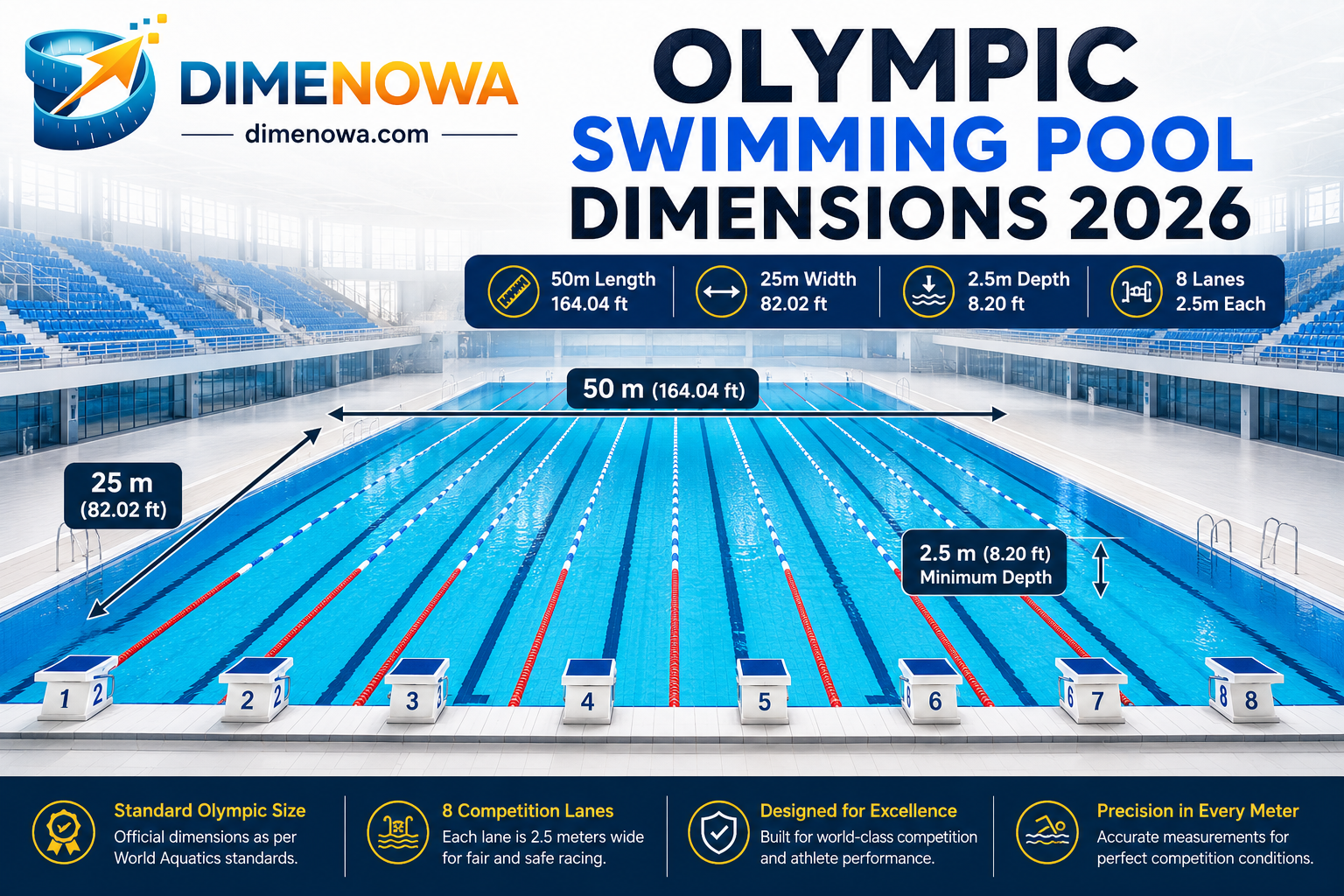
An Olympic swimming pool is designed to meet strict competition requirements established by World Aquatics, the international governing body for swimming. A standard Olympic competition pool is 50 meters long and at least 25 meters wide, with eight competition lanes that are each 2.5 meters wide. Olympic Games pools also require a minimum water depth of 2.5 meters.
The 50-meter length is measured between the appropriate timing touch panels when automatic officiating equipment is used. The pool’s physical construction can therefore be slightly longer than 50 meters to accommodate the required tolerances and equipment.
This guide explains Olympic swimming pool dimensions in meters and feet, lane widths, depth, pool area, approximate water volume, and how Olympic pools differ from standard 25-meter competition pools.
Quick Answer: Olympic Swimming Pool Dimensions
| Measurement | Metric | Imperial |
|---|---|---|
| Pool length | 50 m | 164.04 ft |
| Minimum pool width | 25 m | 82.02 ft |
| Minimum water depth | 2.5 m | 8.20 ft |
| Competition lanes | 8 | 8 |
| Lane width | 2.5 m | 8.20 ft |
| Pool area at 50 × 25 m | 1,250 m² | 13,454.86 sq ft |
| Approx. volume at 2.5 m uniform depth | 3,125 m³ | 825,537 US gal |
Important: The volume above is a mathematical estimate assuming the entire 50 × 25 m pool has a uniform depth of exactly 2.5 m. Actual pool volume can differ because pool depth, equipment, gutters, and other construction features may vary.
What Are the Standard Olympic Swimming Pool Dimensions?
For an Olympic Games swimming pool, World Aquatics specifies a 50-meter competition length and a minimum width of 25 meters for permanent pools. Temporary Olympic pools must be at least 26 meters wide.
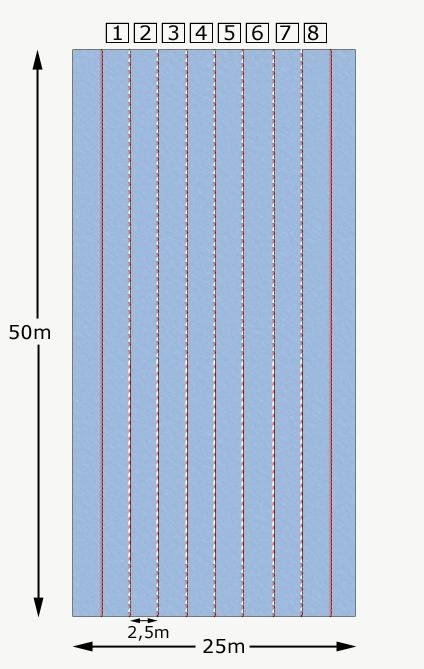
The Olympic competition layout uses eight lanes. Each lane is 2.5 meters wide, with an additional 2.5-meter space outside each of the first and eighth lanes. This arrangement explains the standard 25-meter pool width:
8 × 2.5 m lanes = 20 m
2 × 2.5 m outside spaces = 5 m
Total = 25 m
World Aquatics’ certification documentation specifically states that Olympic Games pools use eight lanes, with two 2.5-meter spaces outside lanes 1 and 8.
Olympic Pool Length
The standard Olympic swimming competition distance is 50 meters.
In imperial units:
50 meters ≈ 164.04 feet
The competition length is measured along the center of the lane. For pools using automatic officiating equipment, the required 50-meter distance is measured between the relevant touch panels. World Aquatics allows a specific construction tolerance so the pool can accommodate the timing equipment while maintaining the required competition distance.
If you want to compare swimming facilities with another major sport, see our guide to Tennis Court Dimensions for standard court measurements and layout.
This is why the actual wall-to-wall construction measurement may be slightly greater than 50 meters.
Why Is an Olympic Pool 50 Meters Long?
The 50-meter pool is known as a long-course pool. Swimming competitions use the 50-meter distance for long-course events, while short-course competitions are held in 25-meter pools.
A 50-meter length also reduces the number of turns required during races compared with a 25-meter pool.
Olympic Pool Width
A permanent Olympic Games swimming pool must be at least:
25 meters wide
That equals approximately:
82.02 feet
The width accommodates the eight 2.5-meter competition lanes plus the two 2.5-meter spaces outside the outer lanes.
For temporary Olympic pools, World Aquatics specifies a minimum width of 26 meters (85.30 feet).
This distinction is important because you may see Olympic pools described as 50 × 25 meters while a temporary competition installation can have a different overall width.
Olympic Swimming Pool Lane Dimensions
Each Olympic competition lane is:
2.5 meters wide
That is approximately:
8.20 feet wide
The Olympic Games certification standard specifies eight lanes, although the regulations allow 9 or 10 lanes in certain unusual circumstances with the required approval.
The lane ropes separate the swimmers and help manage water movement between lanes.
Olympic Pool Lane Layout
| Pool Feature | Measurement |
|---|---|
| Competition lanes | 8 |
| Lane width | 2.5 m |
| Lane width in feet | 8.20 ft |
| Outside space beside lane 1 | 2.5 m |
| Outside space beside lane 8 | 2.5 m |
| Total minimum permanent-pool width | 25 m |
The outer spaces are part of the overall pool-width arrangement and should not be mistaken for additional competition lanes.
Olympic Swimming Pool Depth
An Olympic Games 50-meter swimming pool must have a minimum water depth of 2.5 meters. That is approximately:
8.20 feet
World Aquatics’ current pool certification documentation specifies this minimum depth for 50-meter pools used at the Olympic Games and World Aquatics Championships.
The depth requirement is not the same for every type of aquatic facility. For example, World Aquatics specifies different minimum depths for 25-meter World Aquatics Championship pools and for pools used for multiple aquatic sports.
Therefore, saying that every Olympic pool must be exactly 2.5 meters deep would be inaccurate. The rule establishes a minimum, not necessarily a fixed maximum or uniform depth.
Olympic Pool Area
If we use the standard permanent-pool dimensions of:
50 m × 25 m
the surface area is:
Area = Length × Width
Area = 50 × 25
Area = 1,250 m²
In square feet:
1,250 m² ≈ 13,454.86 sq ft
So the water surface of a 50 × 25-meter Olympic pool covers approximately 1,250 square meters, or 13,455 square feet.
This calculation describes the pool’s rectangular surface area and does not include surrounding deck space, spectator areas, changing facilities, equipment rooms, or other parts of the aquatic venue.
If you’re comparing the space required for different sports, check out our guide to Pickleball Court Dimensions for standard court size and layout.
Olympic Swimming Pool Volume
Pool volume depends on depth.
If we use the minimum 2.5-meter depth throughout the entire 50 × 25-meter pool:
Volume = Length × Width × Depth
Volume = 50 × 25 × 2.5
Volume = 3,125 m³
That equals approximately:
- 3.125 million liters
- 825,537 US gallons
- 687,550 Imperial gallons
These figures are theoretical because they assume a uniform depth of 2.5 meters throughout the entire pool.
A real competition pool may have different structural features, so its actual water capacity can vary.
Olympic Pool Dimensions in Feet
For readers who use imperial measurements, the key dimensions are:
| Measurement | Meters | Feet |
|---|---|---|
| Length | 50 m | 164.04 ft |
| Minimum permanent-pool width | 25 m | 82.02 ft |
| Temporary-pool width | 26 m | 85.30 ft |
| Minimum depth | 2.5 m | 8.20 ft |
| Lane width | 2.5 m | 8.20 ft |
| Pool area | 1,250 m² | 13,454.86 sq ft |
Conversions use:
1 meter = 3.28084 feet
Olympic Pool Dimensions in Meters
The most important measurements can also be summarized entirely in metric units:
| Feature | Standard Measurement |
|---|---|
| Length | 50 m |
| Permanent pool width | Minimum 25 m |
| Temporary pool width | 26 m |
| Minimum depth | 2.5 m |
| Lane width | 2.5 m |
| Number of competition lanes | 8 |
| Outside space beside outer lanes | 2.5 m each |
For official Olympic competition, these dimensions should be considered alongside the full World Aquatics facility and certification requirements rather than as isolated numbers.
Olympic Pool vs. 25-Meter Short-Course Pool
One of the most common mistakes is assuming that every competition swimming pool is 50 meters long.
There are two major competition formats:
| Feature | Olympic / Long Course | Short Course |
|---|---|---|
| Pool length | 50 m | 25 m |
| Length in feet | 164.04 ft | 82.02 ft |
| Primary use | Long-course competition | Short-course competition |
| Turns per race | Fewer | More |
World Aquatics documents distinguish between 50-meter swimming pools and 25-meter pools used for short-course championships.
A 25-meter pool is therefore not half of an Olympic pool in every specification. Other requirements, such as width and depth, can differ depending on the competition and facility type.
How to Measure an Olympic Swimming Pool
If you need to verify the dimensions of a competition pool, use a professional surveying method rather than relying on a casual tape measurement.
Step 1: Measure the Length
Measure the pool along the centerline of the competition lane.
For official competition, the relevant race distance is measured according to the applicable World Aquatics certification requirements and timing equipment.
Step 2: Measure the Width
Measure between the two end walls at the relevant measurement points.
Step 3: Check Lane Width
Each Olympic competition lane should measure 2.5 meters wide.
Step 4: Measure Water Depth
Measure the water depth at the required locations rather than assuming the pool has a uniform depth.
For official certification, World Aquatics requires specific measurement procedures and documentation.
For another popular court-based sport, explore our Badminton Court Dimensions guide to learn about standard court length, width, and playing area.
How Much Space Does an Olympic Pool Need?
The 50 × 25 meter measurement describes the pool itself, not the complete aquatic facility.
A real Olympic swimming venue needs additional space for:
- Pool deck
- Starting blocks
- Officials
- Timing equipment
- Spectator areas
- Athlete circulation
- Changing rooms
- Mechanical equipment
- Filtration systems
- Safety areas
- Accessibility facilities
Therefore, a site measuring exactly 50 × 25 meters would not be large enough to construct a complete Olympic swimming facility.
The total land requirement depends heavily on the venue design and the facilities included around the pool.
Why Olympic Pool Dimensions Matter
Precise dimensions allow swimmers to compete under consistent conditions.
If one competition pool were significantly shorter than another, race times would not be directly comparable. Standardized pool lengths, lane widths, timing systems, and other facility requirements help maintain consistency between major competitions.
Pool depth and lane configuration also affect water movement. Properly designed competition facilities use lane ropes and other features to manage turbulence and create suitable racing conditions.
World Aquatics maintains official swimming facility and certification documentation for competition venues.
Common Mistakes About Olympic Swimming Pool Dimensions
Mistake 1: Assuming Every Olympic Pool Is Exactly 50 × 25 Meters
The familiar 50 × 25 m description is a useful summary of the standard permanent Olympic pool dimensions, but official requirements include tolerances and specific provisions for temporary pools and timing equipment.
Mistake 2: Counting 10 Lanes as the Olympic Standard
The Olympic Games certification standard specifies eight competition lanes, with two additional 2.5-meter spaces outside the outer lanes.
Some swimming facilities use 10 lanes, and World Aquatics has also introduced specific competition formats and trials involving additional lanes. That does not mean every Olympic pool has 10 competition lanes.
Mistake 3: Assuming 2.5 Meters Is the Exact Depth Everywhere
World Aquatics specifies 2.5 meters as the minimum depth for Olympic Games and World Aquatics Championships 50-meter pools. It should not automatically be interpreted as a universal fixed depth.
Mistake 4: Confusing Pool Area With Venue Area
A 1,250 m² figure represents the surface area of a 50 × 25-meter pool. It does not represent the size of the entire swimming complex.
Frequently Asked Questions
How big is an Olympic swimming pool?
A standard permanent Olympic Games pool is 50 meters long and at least 25 meters wide. The competition layout uses eight 2.5-meter lanes plus two 2.5-meter spaces outside the outer lanes.
How deep is an Olympic swimming pool?
For an Olympic Games 50-meter pool, World Aquatics specifies a minimum depth of 2.5 meters, or approximately 8.20 feet.
How many lanes does an Olympic swimming pool have?
The Olympic Games standard specifies eight competition lanes, each 2.5 meters wide. Certain exceptional circumstances may allow additional lanes with approval.
How wide is an Olympic swimming lane?
An Olympic competition lane is 2.5 meters wide, which is approximately 8.20 feet.
How many gallons are in an Olympic swimming pool?
A 50 × 25-meter pool with a uniform 2.5-meter depth would contain approximately 825,537 US gallons. This is a mathematical estimate, not the guaranteed capacity of every Olympic pool.
What is the difference between an Olympic pool and a 25-meter pool?
An Olympic long-course pool is 50 meters long, while a short-course pool is 25 meters long. Other facility requirements can also differ between the two formats.
How many square feet is an Olympic swimming pool?
A 50 × 25-meter pool has a surface area of approximately 13,454.86 square feet.
Is every 50-meter swimming pool an Olympic pool?
No. A 50-meter pool is a long-course pool, but calling it an Olympic-standard pool implies compliance with the applicable Olympic and World Aquatics facility requirements.
Conclusion
The standard Olympic swimming pool is 50 meters long, with a minimum permanent-pool width of 25 meters and a minimum depth of 2.5 meters for a 50-meter Olympic Games pool. The competition layout uses eight lanes, each 2.5 meters wide.
A 50 × 25-meter pool has a surface area of 1,250 m² (13,454.86 sq ft). If the entire pool were uniformly 2.5 meters deep, its theoretical volume would be 3,125 m³, or approximately 825,537 US gallons.
For an actual Olympic facility, however, the pool dimensions are only one part of the requirements. Pool construction tolerances, lane configuration, depth, timing equipment, and the surrounding venue all need to meet the applicable World Aquatics standards.