
Free Calculus Solver Guide: Solve Calculus Problems Step by Step
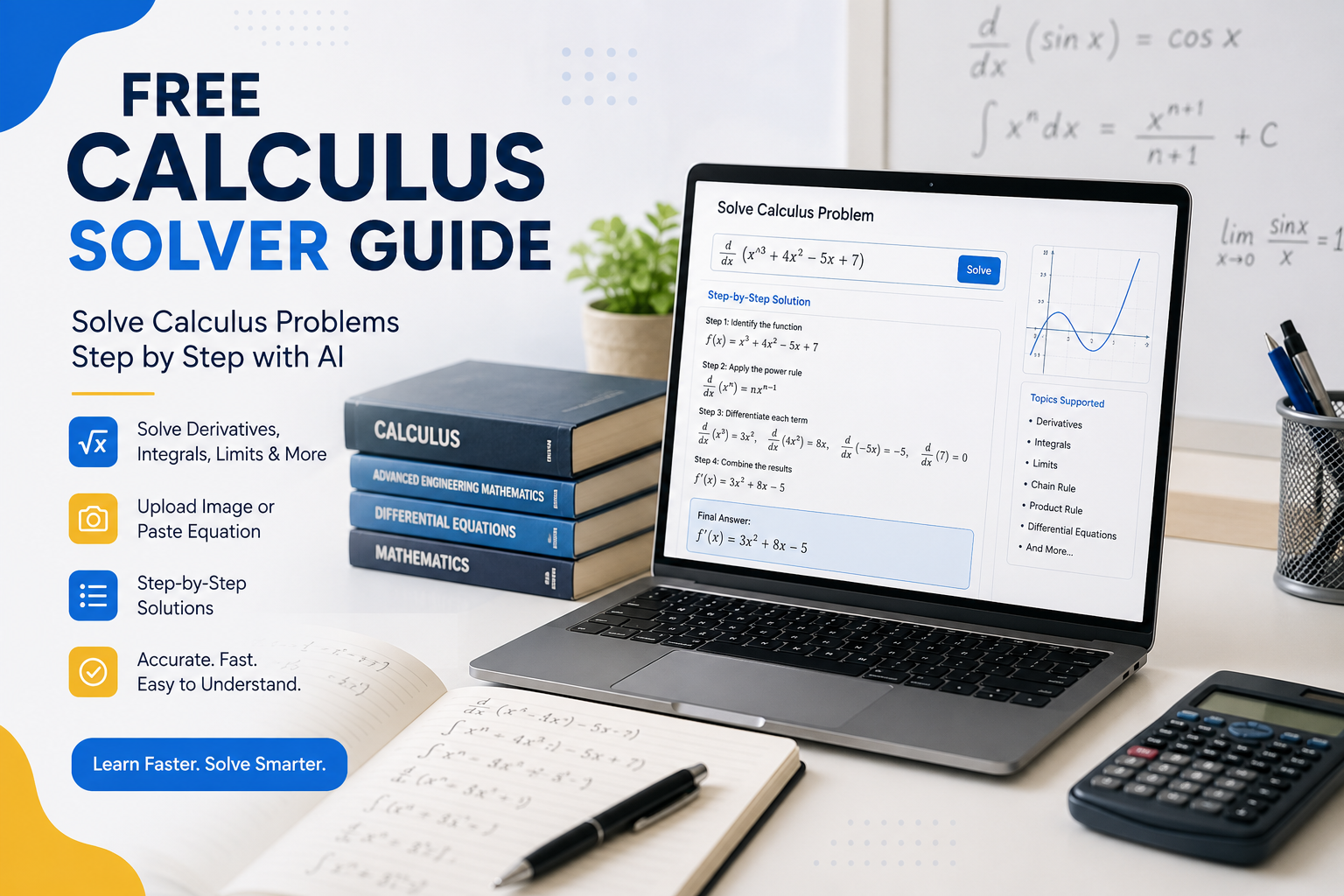
Calculus can be challenging, especially when working with derivatives, integrals, limits, and complex functions. A Free Calculus Solver Guide helps you understand mathematical concepts by providing step-by-step solutions, clear explanations, and faster problem-solving methods. Whether you’re a student preparing for exams, a teacher explaining concepts, or a professional reviewing formulas, an AI-powered calculus solver can make learning more efficient.
Solve Your Calculus Problem
Use the solver by entering your math expression or uploading a clear image of your problem.
- Enter a calculus equation
- Upload a handwritten or printed math image
- Review the step-by-step explanation
- Understand the final answer with confidence
Example Problems:
- d/dx (x² + 5x + 6)
- ∫ (3x² + 2x) dx
- lim x→0 (sin x / x)
- d/dx (eˣ cos x)
Interactive Step-by-Step Calculus Solver & Visualizer
Calculus Solver & Step-Visualizer 🧮
Function enter karein aur derivative ya integral step-by-step solve karein.
What Is a Free Calculus Solver?
A Free Calculus Solver is an online learning tool designed to solve calculus problems quickly while showing each solution step. Instead of displaying only the final answer, modern AI solvers explain the process so users can understand the underlying concepts.
These tools are commonly used for:
- Homework assistance
- Exam preparation
- Self-study
- Classroom learning
- Assignment verification
Upload an Equation or Math Image
Many modern AI math tools allow users to upload a photo of a handwritten or printed calculus problem. Optical Character Recognition (OCR) technology reads the equation and converts it into a digital format before generating a detailed solution.
This feature is especially useful when typing long mathematical expressions is difficult.
Learn how to convert millimetres to centimetres using simple formulas and practical examples.
Topics Supported by a Calculus Solver
A quality calculus solver can assist with many mathematical topics, including:
- Derivatives
- Integrals
- Limits
- Implicit Differentiation
- Chain Rule
- Product Rule
- Quotient Rule
- Partial Derivatives
- Differential Equations
- Optimization Problems
- Related Rates
- Tangent and Normal Lines
How the Solver Works
Most AI-powered calculus solvers follow a simple process:
- Enter or upload your math problem.
- The system recognizes the equation.
- Mathematical algorithms analyze the expression.
- The solution is generated step by step.
- The final answer is displayed along with the calculation process.
This approach helps users learn the method instead of simply copying the answer.
Why Students Prefer AI Calculus Solvers
Students often choose AI-powered calculus tools because they save time and improve understanding. Instead of searching through multiple textbooks, they receive organized solutions in seconds.
Some key benefits include:
- Faster problem solving
- Clear step-by-step explanations
- Better understanding of calculus concepts
- Easy access on desktop and mobile devices
- Helpful for homework, quizzes, and revision
Step-by-Step Solution Example
Understanding the solution process is just as important as getting the correct answer. A good calculus solver explains every step so you can learn the method instead of memorizing the result.
Example:
Problem:
d/dx (x³ + 4x² − 5)
Solution Steps:
- Identify the function.
- Apply the power rule.
- Differentiate each term separately.
- Combine the results.
- Display the final derivative.
This learning approach helps improve problem-solving skills and prepares students for exams.
Compare A4, A5, A6, B5, and Letter Notebook sizes with detailed measurements.
Manual Solving vs AI Calculus Solver

- Manual Solving vs AI Calculus Solver
| Manual Method | AI Calculus Solver |
|---|---|
| Takes more time | Produces results in seconds |
| Requires formula memorization | Explains formulas automatically |
| Higher chance of calculation mistakes | Reduces common calculation errors |
| Difficult for complex equations | Handles advanced calculus problems |
| Best for practice | Best for learning and verification |
Using both methods together is often the most effective way to master calculus.
Who Can Benefit from a Calculus Solver?
A free calculus solver is useful for a wide range of users.
- High school students
- College and university students
- Teachers and tutors
- Engineering students
- Science and mathematics learners
- Professionals reviewing mathematical concepts
Whether you’re solving a simple derivative or a complex integral, step-by-step guidance makes learning easier.
Standardized dimensions are also common in household products, such as the bed and mattress sizes explained in our complete guide.”
Common Calculus Problems You Can Solve
Modern AI calculus tools support many problem types, including:
- First and second derivatives
- Indefinite integrals
- Definite integrals
- Limits
- Optimization problems
- Related rates
- Differential equations
- Implicit differentiation
- Partial derivatives
- Function analysis
Having multiple topics available in one place saves time and improves learning efficiency.
Tips for Getting Accurate Results
For the best experience, follow these simple tips:
- Enter equations using correct mathematical notation.
- Upload a clear, high-quality image if using photo recognition.
- Double-check symbols such as brackets and exponents.
- Review each solution step instead of only the final answer.
- Practice similar questions to strengthen your understanding.
Common Mistakes to Avoid
Many learners struggle with calculus because of small errors. Avoid these common mistakes:
- Entering incomplete equations.
- Ignoring brackets or parentheses.
- Using incorrect mathematical symbols.
- Skipping the explanation steps.
- Depending only on the final answer without understanding the process.
Learning the method behind each solution will help you perform better in homework, assignments, and exams.
Why Choose an AI-Powered Calculus Solver?
AI-powered calculus tools combine speed, accuracy, and detailed explanations in one place. Instead of searching through textbooks or multiple websites, users can quickly solve problems, understand formulas, and build confidence through guided solutions.
Conclusion
A Free Calculus Solver Guide makes learning calculus faster, easier, and more interactive. Whether you’re working on derivatives, integrals, limits, or differential equations, using an AI-powered solver can help you understand each step instead of simply showing the final answer. The best approach is to use these tools as learning companions, allowing you to verify your work, improve problem-solving skills, and build confidence in mathematics over time. For additional information about calculus concepts and mathematical notation, visit the official resources provided by the American Mathematical Society (AMS) or Wolfram MathWorld.
Frequently Asked Questions
1. What is a Free Calculus Solver?
A Free Calculus Solver is an online tool that helps solve calculus problems by providing accurate answers along with detailed step-by-step explanations.
2. Can I solve derivatives online for free?
Yes. Many online calculus solvers can solve first-order and higher-order derivatives while explaining every calculation step.
3. Does an AI calculus solver show step-by-step solutions?
Most modern AI-powered math solvers provide complete step-by-step solutions to help users understand the solving process.
4. Can I upload a photo of a calculus problem?
Many AI math platforms support image uploads, allowing users to scan handwritten or printed equations using OCR technology.
5. Which calculus topics are commonly supported?
Most calculators support:
- Derivatives
- Integrals
- Limits
- Chain Rule
- Product Rule
- Quotient Rule
- Differential Equations
- Partial Derivatives
6. Is a calculus solver useful for students?
Yes. Students use calculus solvers to complete homework, prepare for exams, verify answers, and understand mathematical concepts more effectively.
7. Are AI math solvers accurate?
Reliable AI math solvers are generally accurate for most standard calculus problems. However, it’s always a good practice to review each solution and understand the method used.
8. Can I use a calculus solver on my mobile phone?
Yes. Most modern online calculus solvers work on desktops, tablets, and smartphones without requiring special software.