Basketball Court Dimensions: Official Court Size Guide
- Basketball Court Dimensions Guide
Basketball Court Dimensions are one of the most important aspects of the game, whether you’re building a backyard court, designing a school gymnasium, or simply learning the official rules. Court size affects gameplay, player movement, shooting distance, and overall strategy.
Different organizations such as the NBA, FIBA, NCAA, and NFHS (National Federation of State High School Associations) use slightly different court measurements. Understanding these differences helps players, coaches, architects, and sports enthusiasts choose the correct court layout.
In this guide, you’ll learn the standard basketball court dimensions, including court length, width, hoop height, free throw distance, three-point line, key size, and other important markings.
What Are Basketball Court Dimensions?
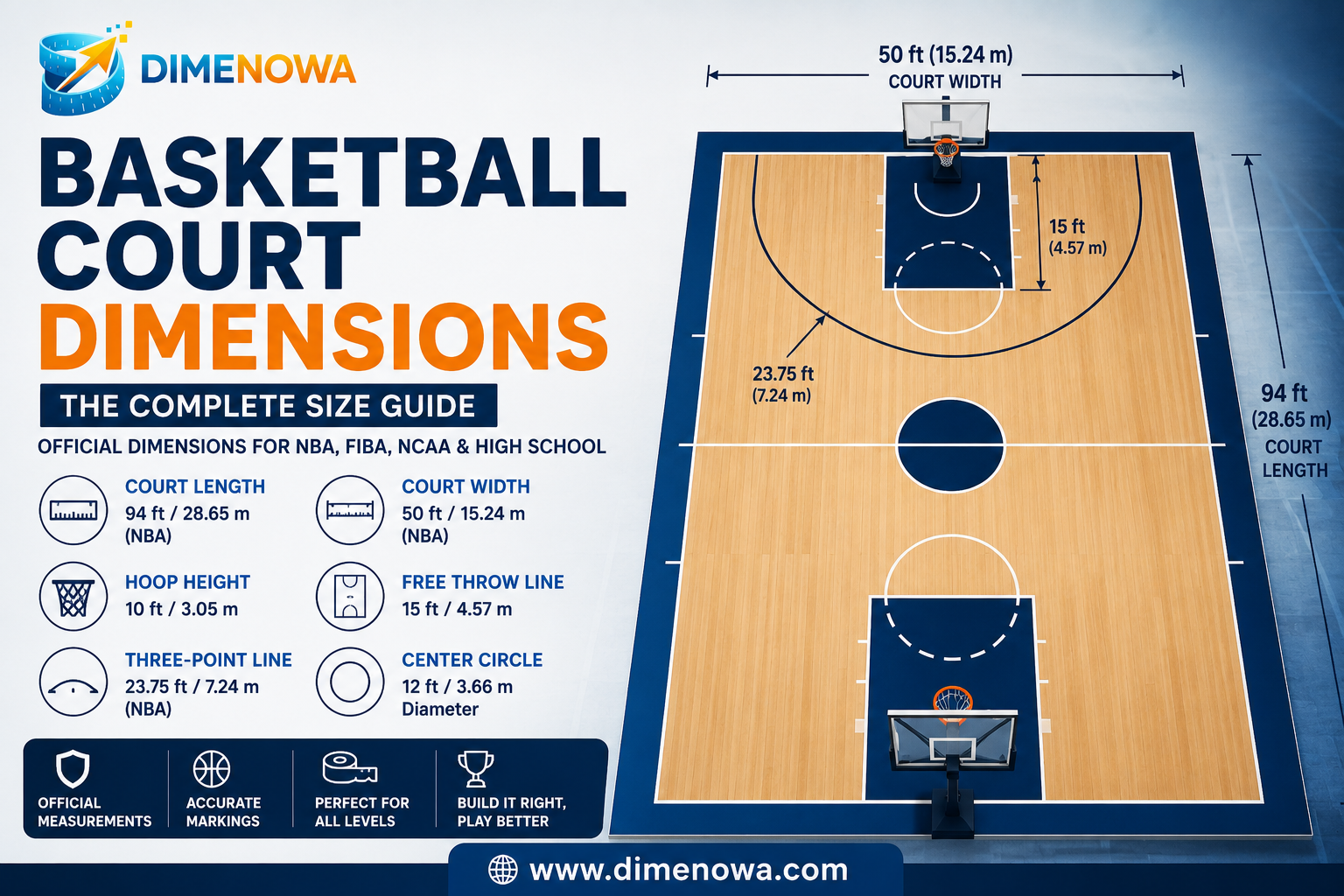
Basketball court dimensions refer to the official measurements of the playing surface and all court markings. These include the overall court size, center circle, free throw lane, three-point arc, restricted area, and basket height.
Most courts follow standards established by organizations like FIBA or the NBA, although schools and recreational facilities may use slightly different measurements.
Standard Basketball Court Dimensions
| Court Feature | Standard Measurement |
|---|---|
| Court Length | 94 ft (28.65 m NBA) / 28 m (FIBA) |
| Court Width | 50 ft (15.24 m NBA) / 15 m (FIBA) |
| Hoop Height | 10 ft (3.05 m) |
| Rim Diameter | 18 in (45.7 cm) |
| Backboard Width | 72 in (183 cm) |
| Free Throw Line | 15 ft (4.57 m) from backboard |
| Center Circle Diameter | 12 ft (3.66 m) |
Although NBA and FIBA courts are very similar, several markings differ slightly depending on the competition. Basketball court markings are often measured in both feet and inches. Learn more in our complete guide to Inch Measurement.
NBA vs FIBA Basketball Court Dimensions
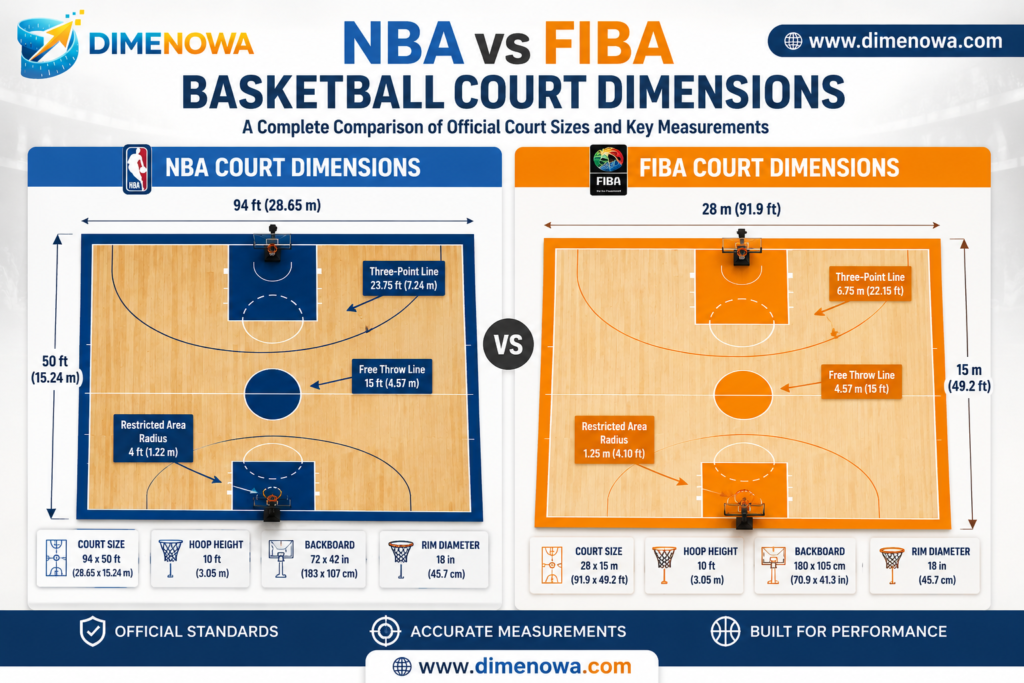
The NBA and FIBA use different court standards for professional basketball.
- NBA vs FIBA Basketball Court Size Comparison
| Feature | NBA | FIBA |
|---|---|---|
| Court Length | 94 ft (28.65 m) | 28 m (91.9 ft) |
| Court Width | 50 ft (15.24 m) | 15 m (49.2 ft) |
| Three-Point Line | 23.75 ft | 6.75 m (22.15 ft) |
| Restricted Area Radius | 4 ft | 1.25 m |
These differences may seem small, but they significantly affect shooting angles and game strategy.
Basketball Court Layout
Every official basketball court contains several marked areas.
These include:
- Center Circle
- Half-Court Line
- Free Throw Lane (Key)
- Three-Point Arc
- Restricted Area
- Baselines
- Sidelines
- Team Benches
- Basket and Backboard
Each marking serves a specific purpose and is regulated by official basketball rules.
Basketball Hoop Dimensions
The basket is identical across nearly all professional and amateur competitions.
| Component | Measurement |
|---|---|
| Hoop Height | 10 ft (3.05 m) |
| Rim Diameter | 18 in (45.7 cm) |
| Backboard Width | 72 in (183 cm) |
| Backboard Height | 42 in (107 cm) |
The 10-foot rim height has remained the international standard for decades.
Free Throw Lane (The Key)
The rectangular painted area beneath the basket is called the key or free throw lane.
Standard Measurements
| Feature | Measurement |
|---|---|
| Free Throw Line | 15 ft (4.57 m) |
| Lane Width (NBA) | 16 ft |
| Lane Width (FIBA) | 4.9 m (16.08 ft) |
The key is used during free throws, rebounding, and defensive positioning.
Three-Point Line Dimensions
The three-point line determines whether a successful field goal is worth two or three points.
| Organization | Three-Point Distance |
|---|---|
| NBA | 23.75 ft (7.24 m) |
| FIBA | 22.15 ft (6.75 m) |
| NCAA Men | 22.15 ft (6.75 m) |
| High School | 19.75 ft (6.02 m) |
As players progress through different levels of basketball, the shooting distance gradually increases.
Basketball Court Dimensions by Competition
Different competitions use different court sizes.
| Competition | Court Size |
|---|---|
| NBA | 94 × 50 ft |
| FIBA | 28 × 15 m |
| NCAA | 94 × 50 ft |
| High School | 84 × 50 ft |
| Junior Basketball | Varies by age group |
If you’re planning to build a court, always use the measurements required for your intended level of play. Interested in other sports size guides? Explore our detailed Skateboard Dimensions article to compare standard deck measurements and sizing.
Choosing the Right Basketball Court Size
The best court dimensions depend on how the court will be used.
Professional arenas require full-size courts that meet NBA or FIBA regulations.
Schools often use NCAA or high school measurements, while many residential courts are built as half courts to save space.
For recreational players, even a smaller practice court can provide excellent training opportunities while requiring less land and construction cost.
Half-Court Basketball Dimensions
A half basketball court is an excellent choice for homes, schools, and community parks where space is limited. It allows players to practice shooting, passing, dribbling, and one-on-one games without requiring a full-size court.
| Court Type | Standard Size |
|---|---|
| NBA Half Court | 47 × 50 ft (14.3 × 15.2 m) |
| FIBA Half Court | 14 × 15 m (45.9 × 49.2 ft) |
| Backyard Practice Court | 30–40 × 30–50 ft |
Half courts are more affordable to build and require less maintenance while still providing an enjoyable playing experience.
Backyard Basketball Court Dimensions
Many homeowners install custom courts based on the available space rather than official league standards.
| Court Size | Best For |
|---|---|
| 30 × 30 ft | Shooting practice |
| 30 × 40 ft | One-on-one games |
| 30 × 50 ft | Recreational play |
| 47 × 50 ft | Official half court |
If space allows, a larger court provides more freedom of movement and a better game experience.
Tips for Choosing the Right Basketball Court
Before building or marking a basketball court, consider these factors:
- Choose court dimensions based on available space.
- Follow NBA or FIBA measurements for competitive play.
- Install a regulation 10-foot hoop.
- Leave extra safety space around the court boundaries.
- Use durable, slip-resistant flooring for outdoor courts.
- Ensure proper lighting if the court will be used at night.
A well-designed court improves safety, gameplay, and long-term durability.
Common Mistakes When Measuring a Basketball Court
Many DIY court projects fail because of incorrect measurements.
Avoid these common mistakes:
- Using the wrong court dimensions for your level of play.
- Forgetting to include the safety area outside the sidelines.
- Incorrectly measuring the three-point arc.
- Installing the hoop lower or higher than 10 feet.
- Using inaccurate line markings.
Taking accurate measurements before construction saves time and prevents costly corrections later.
Real Example
Suppose a school wants to build a basketball court for student tournaments.
Using the official FIBA court dimensions of 28 × 15 meters, a 10-foot hoop, a 6.75-meter three-point line, and a correctly marked free throw lane ensures the court meets international standards and provides students with a professional playing experience. If you’re looking for board sports measurements, don’t miss our complete Longboard Dimensions guide covering deck length, width, wheelbase, and wheel sizes.
Conclusion
Understanding Basketball Court Dimensions is essential for players, coaches, schools, architects, and homeowners planning a basketball facility. From full-size NBA and FIBA courts to compact backyard layouts, every measurement influences gameplay, safety, and player performance. By following official court dimensions and using accurate markings, you can create a court suitable for practice, recreation, or competitive basketball. For official international court specifications and basketball rules, refer to the official FIBA Basketball Rules.
Frequently Asked Questions
What are the official basketball court dimensions?
A standard NBA basketball court measures 94 × 50 feet (28.65 × 15.24 meters), while a FIBA court measures 28 × 15 meters.
How high is a basketball hoop?
The official basketball hoop height is 10 feet (3.05 meters).
What is the size of a high school basketball court?
Most high school basketball courts measure 84 × 50 feet.
How far is the free throw line?
The free throw line is 15 feet (4.57 meters) from the backboard.
What is the NBA three-point line distance?
The NBA three-point line is 23.75 feet (7.24 meters) from the basket at the top of the arc.
Can I build a basketball court in my backyard?
Yes. Many homeowners build half courts or custom-sized courts based on the available space while maintaining a regulation hoop height.
What is the size of a half basketball court?
An NBA half court measures approximately 47 × 50 feet, while recreational half courts can be smaller.
Which basketball court standard is used internationally?
FIBA court dimensions are the international standard for most professional and amateur competitions outside the NBA.