Volleyball Court Dimensions 2026: Official Court Size, Layout & Measurements
Volleyball is one of the world’s most popular team sports, played professionally, recreationally, and in schools across the globe. Whether you’re building a new court, marking an existing playing area, or simply learning the game’s official standards, understanding the Volleyball Court Dimensions 2026 is essential.
The official court dimensions are standardized by the International Volleyball Federation (FIVB), ensuring consistency from local clubs to international tournaments. Every measurement—from the attack line and service area to the free zone and net height—plays a crucial role in fair competition and player safety.
In this guide, you’ll learn the complete volleyball court measurements in feet and meters, court layout, line markings, official net heights, recommended playing space, and the differences between indoor and beach volleyball courts.
Official Volleyball Court Dimensions 2026
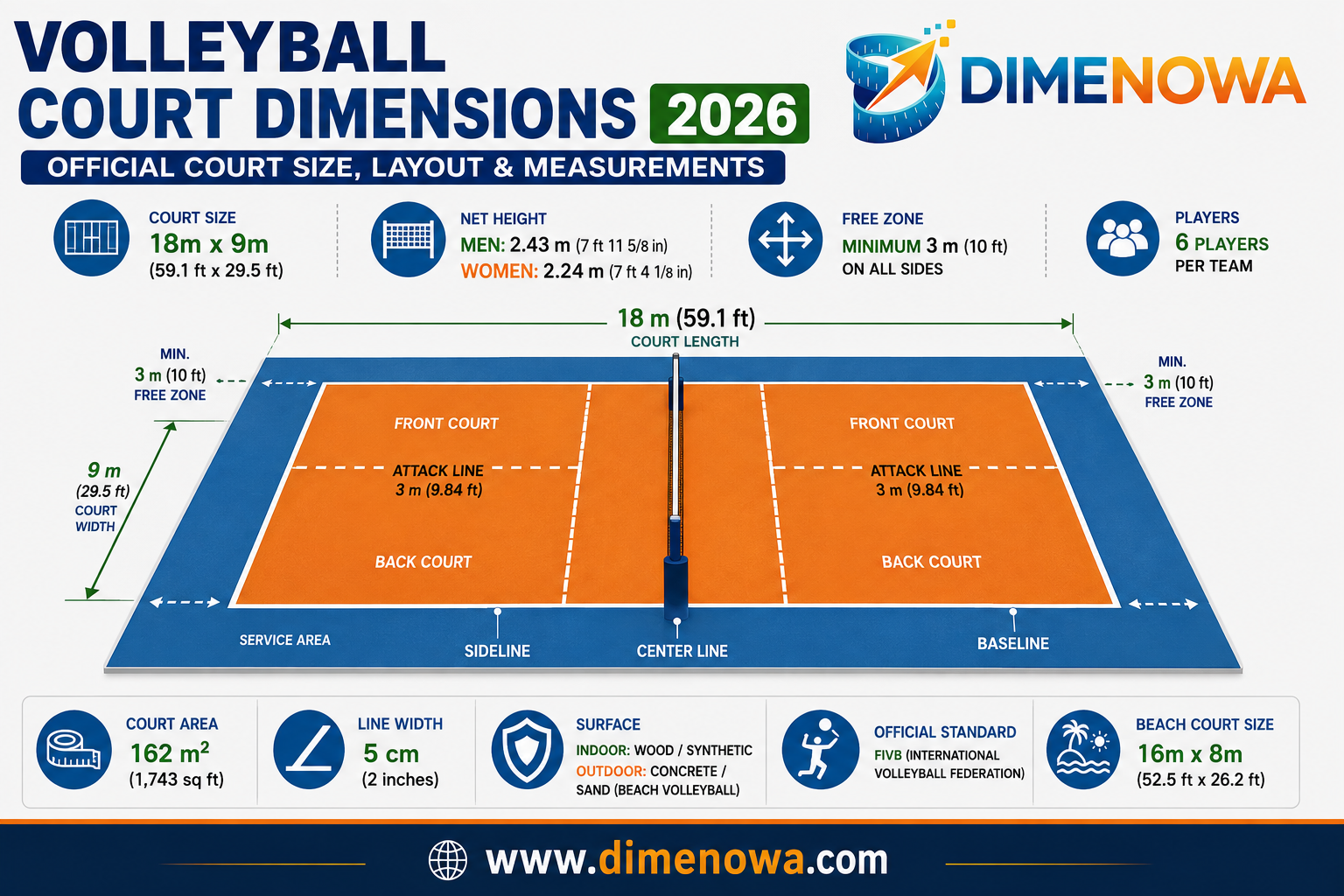
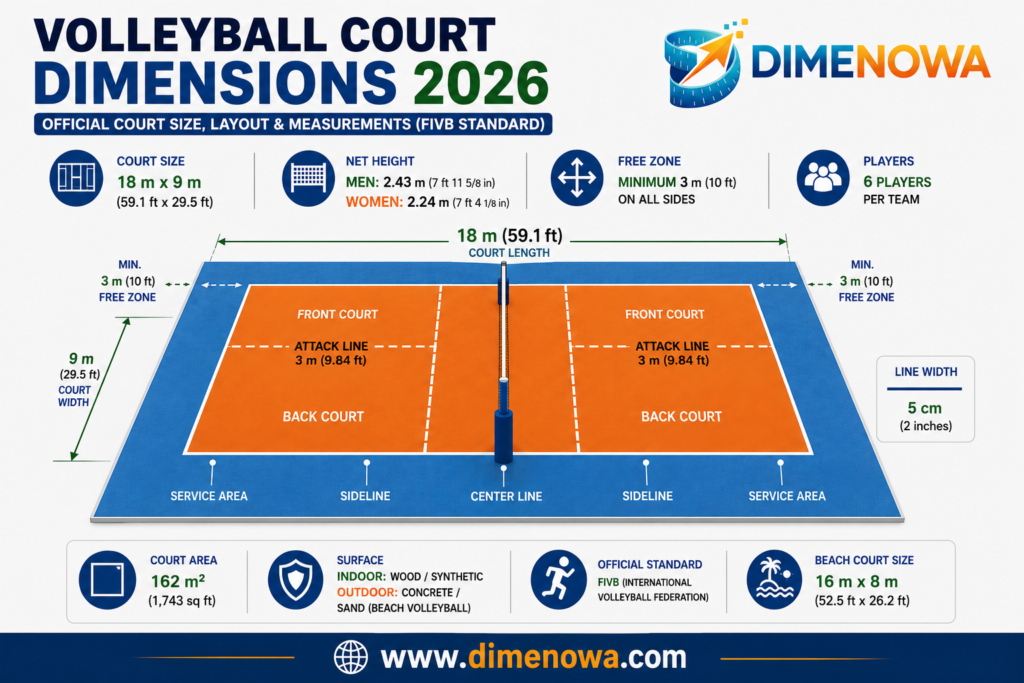
According to FIVB regulations, an official indoor volleyball court measures:
- volleyball-court-dimensions-2026
| Measurement | Feet | Meters |
|---|---|---|
| Court Length | 59.1 ft | 18 m |
| Court Width | 29.5 ft | 9 m |
| Total Court Area | 1,743 sq ft | 162 sq m |
| Attack Line Distance | 9.84 ft | 3 m |
| Center Line | Runs beneath the net | Runs beneath the net |
| Service Area Width | Full width behind baseline | Full width behind baseline |
| Free Zone (Minimum) | 10–16 ft | 3–5 m |
These dimensions apply to international indoor volleyball competitions and are commonly used for schools, colleges, clubs, and professional tournaments.
Volleyball Court Layout Explained
An official volleyball court consists of several clearly marked areas that define player positions, serving zones, and attack boundaries.
Center Line
The center line divides the court into two equal halves measuring 9 × 9 meters. It runs directly beneath the volleyball net and separates the two competing teams.
Attack Line (3-Meter Line)
The attack line is positioned 3 meters (9.84 feet) from the center line on each side.
This line:
- Separates the front court and back court
- Restricts back-row players from attacking in front of the line
- Helps referees judge legal attacking plays
The attack line is one of the most important markings in competitive volleyball.
Baselines
The baselines form the back boundary of the court.
Players must serve from behind the baseline while keeping the ball within the court boundaries after crossing the net.
Sidelines
The sidelines run along both sides of the court and define the playing width.
Any ball landing completely outside these lines is considered out.
Interested in other court sports? Compare sizes with our Basketball Court Dimensions guide and see how volleyball courts differ.
Volleyball Court Dimensions Diagram (Measurements)
               18 m (59.1 ft)

┌───────────────────────────────────────┐
│               Baseline                │
│                                       │
│      Front Court (3 m)                │
│────────────Attack Line────────────────│
│                                       │
│               Net                     │
│==============Center Line==============│
│                                       │
│────────────Attack Line────────────────│
│      Front Court (3 m)                │
│                                       │
│               Baseline                │
└───────────────────────────────────────┘

          Width = 9 m (29.5 ft)
This layout shows the official court dimensions along with the center line, attack lines, baselines, and overall playing area.
Volleyball Court Line Dimensions
Each court line has a specific function during play.
| Court Line | Official Measurement |
|---|---|
| Baseline | 9 m (29.5 ft) |
| Sideline | 18 m (59.1 ft) |
| Attack Line | 3 m (9.84 ft) from center line |
| Center Line | Divides court equally |
| Line Width | 5 cm (2 inches) |
The lines should be bright, clearly visible, and contrast with the court surface for accurate officiating.
Official Volleyball Net Height
Net height varies depending on the competition category.
| Category | Height |
|---|---|
| Men’s Volleyball | 2.43 m (7 ft 11⅝ in) |
| Women’s Volleyball | 2.24 m (7 ft 4⅛ in) |
| Junior Competitions | Varies by age group |
The net stretches across the entire width of the court and is supported by poles positioned just outside the sidelines.
Recommended Playing Area
While the court itself measures 18 × 9 meters, additional clearance is necessary for safe movement.
| Area | Recommended Size |
|---|---|
| Free Zone | Minimum 3 m on all sides |
| Professional Events | Up to 5 m on sidelines and 8 m behind baselines |
| Indoor Ceiling Height | Minimum 7 m |
| International Competitions | Up to 12.5 m clearance |
Adequate free space allows players to chase the ball safely without colliding with walls or spectators.
Looking for another fast-growing paddle sport? Check out our detailed Pickleball Court Dimensions guide for official court measurements.
Indoor vs Outdoor Volleyball Court Dimensions
The indoor court dimensions remain the same worldwide, but beach volleyball uses different measurements.
| Feature | Indoor Volleyball | Beach Volleyball |
|---|---|---|
| Court Size | 18 × 9 m | 16 × 8 m |
| Surface | Hardwood or Synthetic | Sand |
| Players | 6 per team | 2 per team |
| Attack Line | Yes | No |
| Court Markings | Painted Lines | Boundary Ribbons |
Understanding these differences helps players transition between indoor and beach volleyball more easily.
Volleyball Court Surface Options
Selecting the right playing surface is just as important as using the correct court dimensions. The surface affects ball bounce, player comfort, traction, and overall safety.
Hardwood Flooring
Hardwood is the preferred surface for professional indoor volleyball. It provides consistent ball response, excellent grip, and long-lasting durability.
Synthetic Sports Flooring
Many schools and sports complexes use synthetic flooring because it requires less maintenance while offering good shock absorption for players.
Concrete with Sports Coating
Outdoor volleyball courts are often built on concrete and finished with an acrylic sports coating. This creates a durable, weather-resistant playing surface.
Sand Surface
Beach volleyball courts use specially graded sand to reduce injuries and improve player movement. The sand should be soft, clean, and free of rocks or debris.
Free Zone Requirements
The free zone is the open area surrounding the volleyball court where players can safely chase the ball.
Recommended free zone dimensions include:
- Minimum 3 meters (10 feet) on all sides
- Professional events may require up to 5 meters on the sidelines
- International competitions often use up to 8 meters behind each baseline
- The playing area should be free from obstacles such as benches, poles, or walls
A properly designed free zone improves both player safety and match quality.
School and Backyard Volleyball Courts
Not every volleyball court needs to meet international tournament standards. Schools and homeowners often adjust the surrounding space while keeping the official court dimensions.
Recommended setup includes:
| Feature | Suggested Size |
|---|---|
| Court Size | 18 × 9 m (59.1 × 29.5 ft) |
| Backyard Playing Area | At least 24 × 15 m |
| Net Height | Based on player category |
| Surface | Grass, synthetic turf, concrete, or sand |
Maintaining the official court measurements allows players to practice under realistic game conditions.
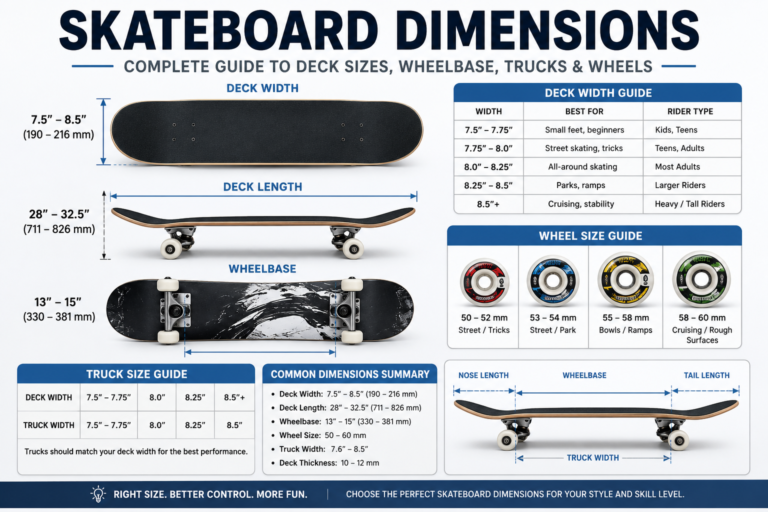
If you enjoy board sports, read our Skateboard Dimensions guide to learn about deck sizes and standard measurements.
Beach Volleyball Court Dimensions
Although both sports share similar rules, beach volleyball uses a smaller court.
| Measurement | Beach Volleyball |
|---|---|
| Court Length | 16 m (52.5 ft) |
| Court Width | 8 m (26.2 ft) |
| Court Area | 128 sq m |
| Players | 2 per team |
| Attack Line | None |
| Surface | Sand |
The smaller court reflects the increased physical demands of playing on sand with only two players.
Volleyball Court vs Basketball Court
Many indoor sports facilities contain multiple court markings. Understanding the differences helps avoid confusion.
| Feature | Volleyball | Basketball |
|---|---|---|
| Court Size | 18 × 9 m | 28 × 15 m |
| Playing Surface | Hardwood/Synthetic | Hardwood |
| Net | Yes | No |
| Goal | Volleyball Net | Basketball Hoop |
| Team Size | 6 Players | 5 Players |
Basketball courts are significantly larger and use completely different line markings.
Common Mistakes When Marking a Volleyball Court
Incorrect measurements can affect gameplay and even make the court unsuitable for competitions.
Avoid these common mistakes:
- Measuring from the outside instead of the inside edge of the lines
- Placing the attack line at the wrong distance
- Installing the net at an incorrect height
- Using faded or narrow court markings
- Leaving insufficient free zone around the court
- Forgetting to level the playing surface before marking lines
Checking all measurements twice before painting can prevent costly corrections later.
Why Official Volleyball Court Dimensions Matter
Following official dimensions offers several important benefits.
- Ensures fair competition
- Improves player safety
- Meets FIVB standards
- Provides consistent ball movement
- Helps athletes prepare for tournaments
- Simplifies coaching and training sessions
Whether you’re building a community court or organizing competitive matches, using regulation measurements creates a better experience for everyone.
Winter sports enthusiasts can also explore our Snowboard Size Guide and Surfboard Dimensions guide to choose the right equipment based on height and skill level.
Conclusion
Understanding the official Volleyball Court Dimensions 2026 is essential for players, coaches, schools, sports clubs, and anyone planning to build a volleyball court. The standard indoor court measures 18 meters (59.1 feet) long and 9 meters (29.5 feet) wide, with clearly marked attack lines, center line, service area, and the correct net height for men’s and women’s competitions.
Following official FIVB measurements ensures fair play, improves player safety, and creates a professional playing environment. Whether you’re constructing a backyard court, upgrading a school gymnasium, or preparing for competitive tournaments, using the official Volleyball Court Dimensions 2026 guarantees consistency with international standards and provides the best possible playing experience.
Frequently Asked Questions (FAQs)
1. What are the official Volleyball Court Dimensions 2026?
The official indoor volleyball court measures 18 meters (59.1 feet) long and 9 meters (29.5 feet) wide according to FIVB regulations.
2. What is the official volleyball net height?
The official net height is:
- Men’s volleyball: 2.43 meters (7 ft 11⅝ in)
- Women’s volleyball: 2.24 meters (7 ft 4⅛ in)
3. How far is the attack line from the net?
The attack line is located 3 meters (9.84 feet) from the center line on each side of the court.
4. How much free space should surround a volleyball court?
A minimum free zone of 3 meters (10 feet) should surround the court, while professional competitions often require larger safety areas.
5. Are indoor and beach volleyball courts the same size?
No. Indoor volleyball courts measure 18 × 9 meters, while beach volleyball courts measure 16 × 8 meters.
6. What surface is best for a volleyball court?
Hardwood flooring is considered the best option for indoor courts, while concrete with an acrylic sports coating or sand is commonly used for outdoor volleyball.
7. Who determines the official volleyball court dimensions?
The International Volleyball Federation (FIVB) establishes the official court dimensions and competition standards used worldwide.
8. Can a volleyball court be built in a backyard?
Yes. As long as you have enough space, you can build a regulation-size volleyball court or a scaled-down recreational version for family and casual play.