Cricket Ball Dimensions: Official Size, Weight & Measurements
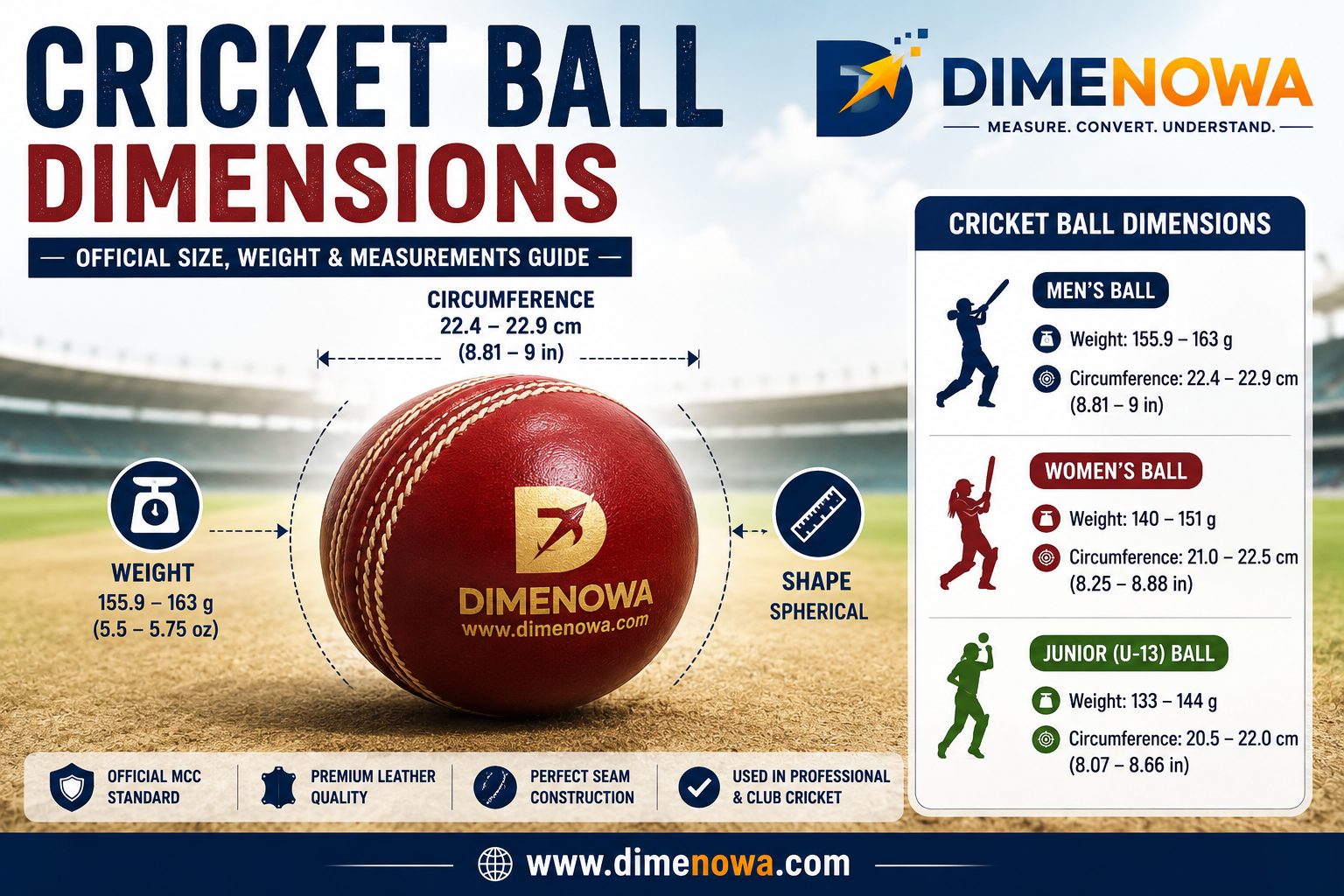
Cricket balls are carefully manufactured to meet specific size and weight requirements so players can experience consistent handling, bounce, swing, and performance. Although a cricket ball looks relatively small, its circumference and weight are important parts of the Laws of Cricket.
For anyone researching Cricket Ball Dimensions, the official measurements vary slightly depending on whether the ball is used in men’s, women’s, or junior cricket. The standard also applies to a new ball, so understanding these ranges is useful when buying or comparing cricket equipment.
What Are the Standard Cricket Ball Dimensions?
Under the Laws of Cricket, a new ball used in men’s cricket must weigh between 155.9 and 163 grams and have a circumference between 22.4 and 22.9 centimeters. These measurements are specified by the Marylebone Cricket Club (MCC), the custodian of the Laws of Cricket.
| Measurement | Men’s Cricket |
|---|---|
| Weight | 155.9–163 g |
| Weight in ounces | 5.5–5.75 oz |
| Circumference | 22.4–22.9 cm |
| Circumference in inches | 8.81–9 in |
| Shape | Spherical |
The 2026 edition of the Laws retains these core ball specifications. MCC has announced that the fourth edition of the 2017 Code comes into force on October 1, 2026.
Cricket Ball Weight
The official weight of a new men’s cricket ball is between 155.9 grams and 163 grams. In Imperial units, this is 5.5 to 5.75 ounces.
This relatively narrow range helps maintain consistency between balls used in competitive cricket. A cricket ball’s weight can influence how it feels in the hand, how quickly it travels after being struck, and how bowlers control their deliveries.
The ball can naturally change during a match because of wear, moisture, impact, and contact with the playing surface.
Cricket Ball Circumference
The circumference of a new men’s cricket ball must be between 22.4 and 22.9 cm, or approximately 8.81 to 9 inches.
Unlike a cricket bat, which has multiple length and width measurements, a cricket ball is primarily specified by its circumference and weight.
If you need to convert cricket ball measurements between metric units, check our Millimetre to Centimetre Conversion guide.
A flexible measuring tape can be wrapped around the widest part of the spherical ball to check its circumference.
Cricket Ball Size in Inches and Centimeters
For quick reference, the standard men’s cricket ball measurements can be converted as follows:
| Measurement | Metric | Imperial |
|---|---|---|
| Minimum circumference | 22.4 cm | 8.81 in |
| Maximum circumference | 22.9 cm | 9 in |
| Minimum weight | 155.9 g | 5.5 oz |
| Maximum weight | 163 g | 5.75 oz |
These measurements are useful when comparing specifications from different cricket-ball manufacturers.
Women’s Cricket Ball Dimensions
Women’s cricket uses a slightly smaller and lighter ball than the men’s specification.
Under the Laws of Cricket, a new women’s cricket ball weighs from 140 to 151 grams and has a circumference from 21.0 to 22.5 cm.
| Measurement | Women’s Cricket |
|---|---|
| Weight | 140–151 g |
| Circumference | 21.0–22.5 cm |
| Weight in ounces | Approximately 4.94–5.31 oz |
| Circumference in inches | Approximately 8.25–8.88 in |
The difference allows the ball to be appropriate for the playing conditions and regulations of women’s cricket.
For another sports equipment measurement guide, explore our Cricket Bat Dimensions.
Junior Cricket Ball Dimensions
Junior cricket also uses smaller specifications. For Under-13 cricket, the Laws specify a new ball weighing 133–144 grams with a circumference of 20.5–22.0 cm.
| Category | Weight | Circumference |
|---|---|---|
| Men’s | 155.9–163 g | 22.4–22.9 cm |
| Women’s | 140–151 g | 21.0–22.5 cm |
| Under-13 | 133–144 g | 20.5–22.0 cm |
This comparison shows why choosing a cricket ball based only on appearance is not enough. The appropriate size depends on the level and playing category.
How Is a Cricket Ball Made?
A traditional cricket ball consists of a solid core surrounded by layers of materials and covered with leather. The leather outer surface contains prominent stitching, commonly called the seam.
The seam is particularly important in cricket because bowlers can use it to influence the ball’s movement after delivery. The condition of the leather and seam can also change as the ball becomes older.
For more details about the playing area, check our Cricket Pitch Dimensions guide to learn about standard pitch length, width, and markings.
Different manufacturers may use different construction techniques and finishes, but balls intended for regulated competitions must comply with the applicable specifications.
Why Cricket Ball Dimensions Matter
Ball dimensions influence more than just the appearance of the equipment.
A consistent weight and circumference help provide predictable handling for:
- Bowlers
- Batters
- Wicketkeepers
- Fielders
- Umpires
For bowlers, the ball’s condition and seam can affect swing and seam movement. For batters, the weight and size influence timing and control.
For coaches and players, using the correct ball is therefore an important part of preparing for training and competition.
How to Measure a Cricket Ball
You can check a cricket ball’s basic measurements with simple equipment.
- Use a digital kitchen or sports scale to measure weight.
- Wrap a flexible measuring tape around the ball.
- Make sure the tape sits evenly around the circumference.
- Record the measurement in centimeters or inches.
- Compare the result with the appropriate competition specification.
For an official match, however, the umpires and governing body determine whether a ball is suitable for play. MCC’s Laws state that balls used in a match are under the umpires’ control.
If you are interested in winter sports equipment, explore our Snowboard Size guide.
Cricket Ball Dimensions vs Other Sports Balls
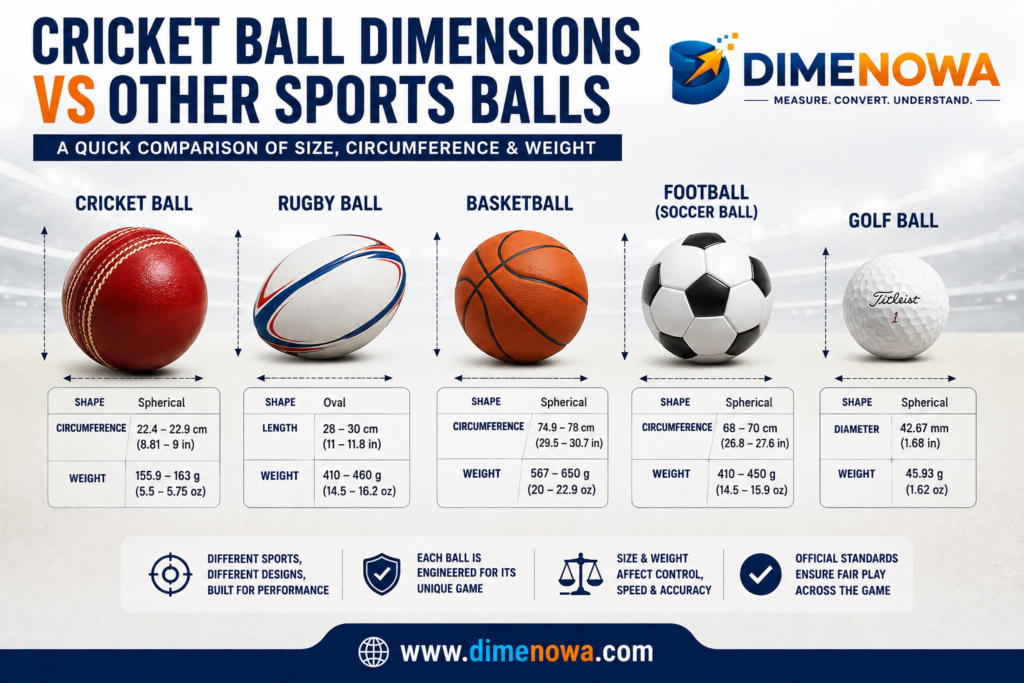
Cricket balls are considerably smaller than many popular sports balls, but their weight is relatively substantial for their size.
| Sports Ball | Shape | Approximate Characteristic |
|---|---|---|
| Cricket ball | Spherical | Small, dense and relatively heavy |
| Rugby ball | Oval | Larger and elongated |
| Basketball | Spherical | Much larger circumference |
| Golf ball | Spherical | Much smaller and lighter |
| Baseball | Spherical | Similar compact sports-ball design |
The comparison highlights how each sport’s ball is designed around its specific playing requirements.
Frequently Asked Questions
What is the standard cricket ball size?
A new men’s cricket ball must have a circumference between 22.4 and 22.9 cm, or 8.81 to 9 inches.
How much does a cricket ball weigh?
A new men’s cricket ball weighs between 155.9 and 163 grams.
Is a women’s cricket ball smaller?
Yes. The women’s specification is 140–151 grams in weight and 21.0–22.5 cm in circumference.
What are the dimensions of a junior cricket ball?
For Under-13 cricket, the specified weight is 133–144 grams and the circumference is 20.5–22.0 cm.
How many inches is a cricket ball?
A men’s cricket ball has a circumference of approximately 8.81–9 inches.
Does a cricket ball have a standard diameter?
The Laws specify the ball’s circumference rather than a specific diameter. Because the ball is spherical, its approximate diameter can be calculated from the circumference, but the official specification is given as circumference.
Who sets the Laws for cricket?
The Marylebone Cricket Club (MCC) is the custodian of the Laws of Cricket, while the International Cricket Council (ICC) is the global governing body for cricket.
Do cricket balls change size during a match?
The ball naturally becomes worn during play. However, the official dimensions specified by the Laws apply to the ball when new.
Conclusion
Understanding Cricket Ball Dimensions is important when selecting equipment for training, school cricket, club matches, or professional competition. A new men’s cricket ball weighs 155.9–163 grams and has a circumference of 22.4–22.9 cm, while women’s and junior specifications use slightly smaller and lighter balls.
These measurements help maintain consistency across the game and allow players to use equipment appropriate for their playing category. Whether you are comparing cricket balls or simply learning about sports dimensions, checking the official specifications is always the best way to understand the correct size.