Rugby Ball Dimensions: Official Size, Weight & Measurements
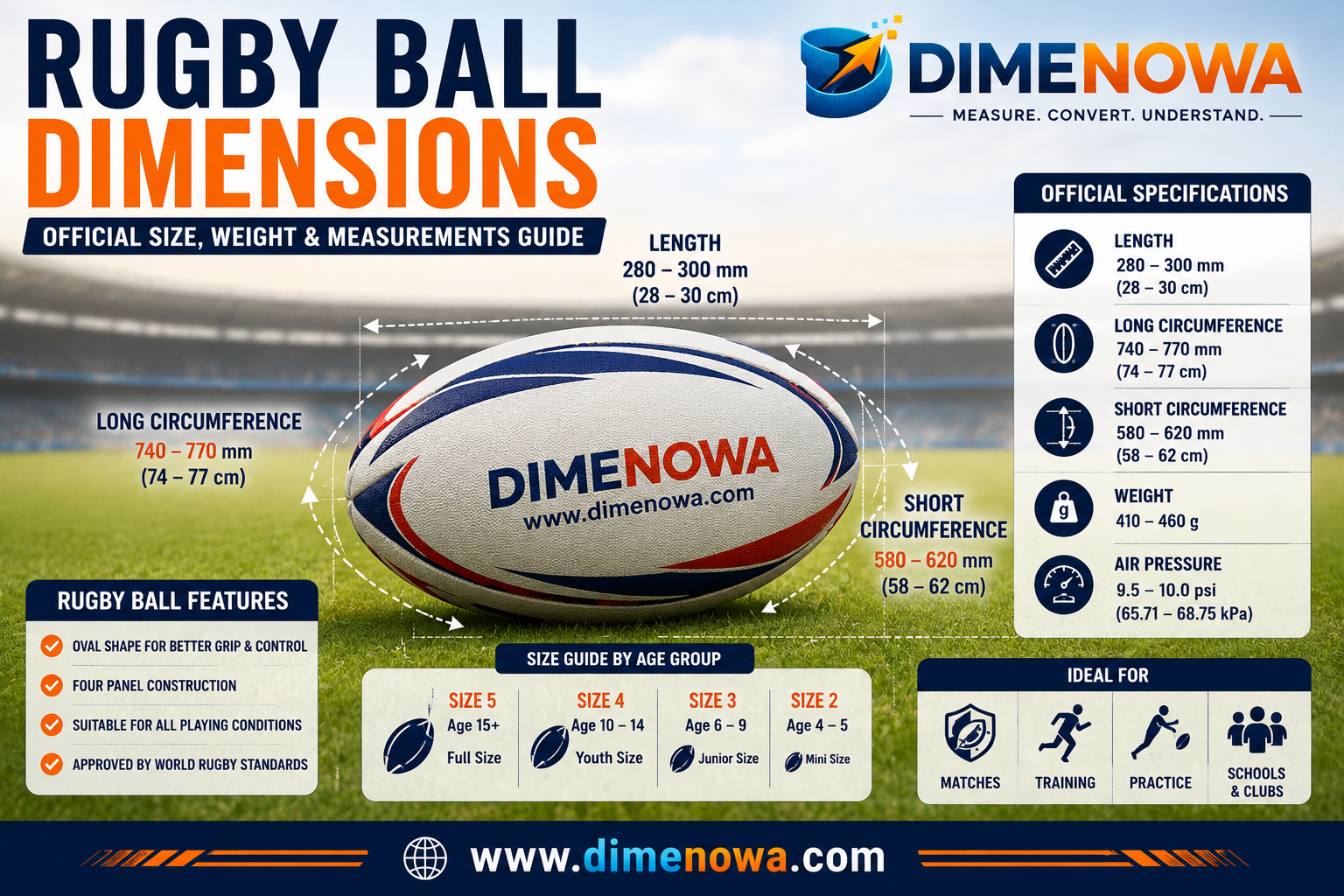
Rugby balls have a distinctive oval shape that separates them from most other sports balls. Their size, weight, circumference, and air pressure are controlled by official playing standards so that players can expect consistent handling and performance.
Whether you are choosing a rugby ball for training, checking the specifications of a match ball, or comparing rugby equipment, understanding the standard measurements makes it easier to select the right ball.
Standard Rugby Ball Dimensions
World Rugby specifies the dimensions and weight of the ball used in rugby union. The official ball is oval and consists of four panels. Its dimensions are given as ranges rather than one single measurement.
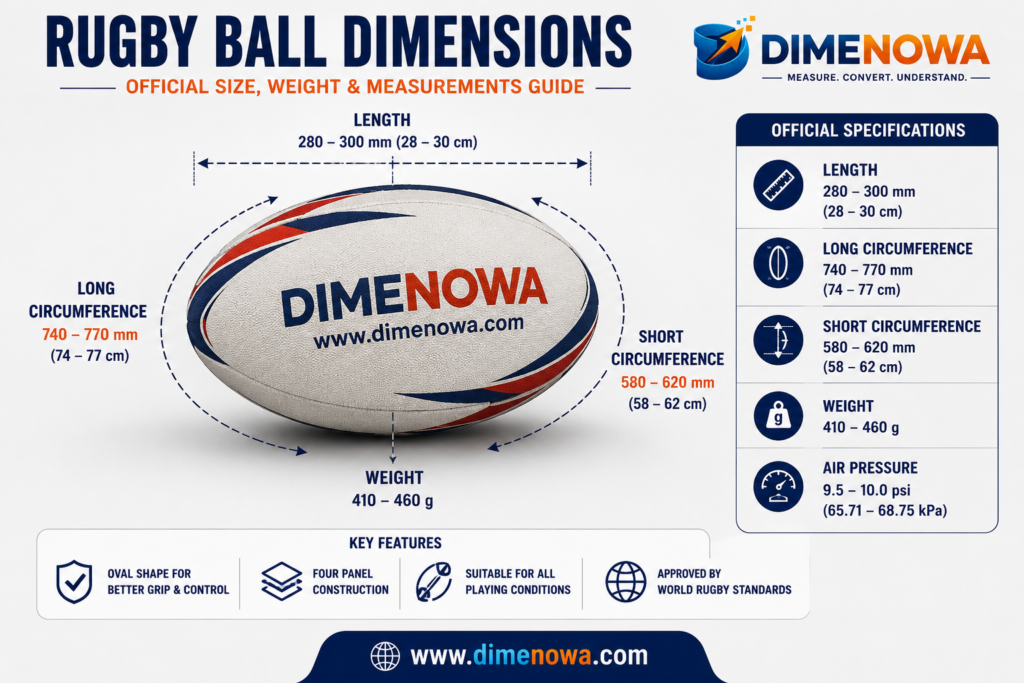
Rugby ball dimensions showing official length, circumference, weight and measurements
| Measurement | Official Range |
|---|---|
| Ball length | 280–300 mm |
| Long circumference | 740–770 mm |
| Short circumference | 580–620 mm |
| Weight | 410–460 g |
| Starting pressure | 9.5–10.0 psi |
The same measurements can also be expressed in centimeters:
| Measurement | Centimeters |
|---|---|
| Length | 28–30 cm |
| Long circumference | 74–77 cm |
| Short circumference | 58–62 cm |
| Weight | 410–460 g |
These specifications are particularly useful when comparing products described as regulation or match-quality rugby balls.
Rugby Ball Length
The standard rugby ball length is between 280 and 300 millimeters, which equals 28 to 30 centimeters.
Unlike a spherical football or basketball, a rugby ball is measured along its longest dimension. The elongated shape gives the ball its characteristic appearance and affects how it travels through the air.
A ball near the middle of the permitted range may measure approximately 29 cm long, although individual approved balls can vary within the official limits.
Rugby Ball Circumference
Rugby balls have two important circumference measurements because of their oval shape.
The longer circumference is between 740 and 770 mm, while the shorter circumference is between 580 and 620 mm.
This distinction is important because measuring only around the widest part does not fully describe the dimensions of an oval rugby ball.
If you want to compare rugby equipment with another ball sport, check our detailed guide to Golf Ball Dimensions.
Rugby Ball Weight
An official rugby ball weighs between 410 and 460 grams.
That weight range helps provide a consistent feel when passing, kicking, catching, and carrying the ball during competitive play.
A ball that is substantially outside the specified range may not provide the same handling characteristics as a regulation match ball.
Rugby Ball Air Pressure
World Rugby specifies a starting air pressure of 65.71–68.75 kilopascals, equivalent to approximately 9.5–10.0 pounds per square inch (psi).
Correct inflation matters because pressure can affect:
- Ball grip
- Bounce
- Passing
- Kicking
- Catching
- Overall handling
Players should therefore check the manufacturer’s inflation instructions as well as the competition requirements before using a ball in a match.
For a comparison of playing areas across different sports, explore our Basketball Court Dimensions guide.
Rugby Ball Size by Player Age
Not every rugby player uses the full-size ball. World Rugby’s laws allow smaller balls for matches involving young players.
Manufacturers commonly offer different ball sizes for youth development. However, the exact age recommendations can vary by rugby union, competition, school, and manufacturer.
A smaller ball can make it easier for young players to develop basic skills such as passing, catching, and kicking before progressing to a full-size match ball.
What Is a Regulation Rugby Ball?
A regulation rugby ball is designed to meet the specifications required by the applicable competition. For rugby union, World Rugby’s Laws of the Game specify the ball’s dimensions, weight, construction, and starting pressure.
The ball must be oval and made from four panels. It may be constructed from leather or a suitable synthetic material, and the material can be treated to improve water resistance and grip.
This is why simply buying an oval-shaped ball does not necessarily mean that it meets official match specifications.
Rugby Ball vs American Football
Rugby balls and American footballs look similar at first glance, but their specifications and playing characteristics differ.
| Feature | Rugby Ball | American Football |
|---|---|---|
| Shape | Oval | Pointed oval |
| Construction | Commonly four panels | Different panel construction |
| Main Use | Rugby | American football |
| Handling | Designed for passing and carrying | Designed around throwing and carrying |
| Governing Standards | World Rugby | Football governing bodies |
The two sports should not be assumed to use interchangeable balls simply because both have an elongated shape.
How to Measure a Rugby Ball
If you want to check the dimensions of a rugby ball at home, use a flexible measuring tape and a ruler.
- Measure the longest dimension from end to end.
- Wrap the tape around the widest section to measure the long circumference.
- Measure the shorter circumference around the narrower section.
- Use a suitable scale to check the ball’s weight.
- Use a pressure gauge to check inflation.
For an official match ball, measurements should be compared with the applicable competition specifications rather than relying only on visual appearance.
You can also compare rugby field requirements with our Hockey Rink Dimensions guide and its official rink measurements.
Why Rugby Ball Dimensions Matter
Consistent dimensions help create predictable playing characteristics. The ball’s length, circumference, weight, shape, and pressure influence how it feels in the hands and how it behaves when kicked or passed.
For coaches, players, schools, and sports facilities, knowing the correct measurements also helps when purchasing replacement balls or preparing equipment for competition.
Frequently Asked Questions
What are the standard rugby ball dimensions?
A standard rugby union ball is 280–300 mm long, with a long circumference of 740–770 mm and a short circumference of 580–620 mm.
How much does a rugby ball weigh?
An official rugby ball weighs between 410 and 460 grams.
How long is a rugby ball in centimeters?
The official length range is 28–30 cm.
What pressure should a rugby ball have?
World Rugby specifies a starting pressure of 9.5–10.0 psi for the rugby union ball.
Are youth rugby balls smaller?
Yes. World Rugby allows smaller balls for matches involving young players, with specific size choices depending on the level and competition.
Why is a rugby ball oval?
The oval design is fundamental to the way the ball is carried, passed, kicked, and caught during rugby.
Is every rugby ball the same size?
No. Approved adult balls can vary within the official measurement ranges, while youth rugby uses smaller balls.
Who sets the rugby union ball standards?
World Rugby establishes the Laws of the Game for rugby union, including the specifications for the ball.
Conclusion
Understanding Rugby Ball Dimensions helps players, coaches, parents, and sports enthusiasts choose equipment with greater confidence. An official rugby union ball is 280–300 mm long, weighs 410–460 grams, and has specified long and short circumference ranges. Its inflation pressure is also controlled to provide consistent playing characteristics.
For another field-based sport, see our Cricket Pitch Dimensions guide to learn about standard playing-area measurements.
Whether you are buying a training ball or preparing for competitive rugby, checking the correct dimensions, weight, and pressure can make a noticeable difference in equipment selection and performance.