Millimetre to Centimetre Conversion: Easy mm to cm Guide
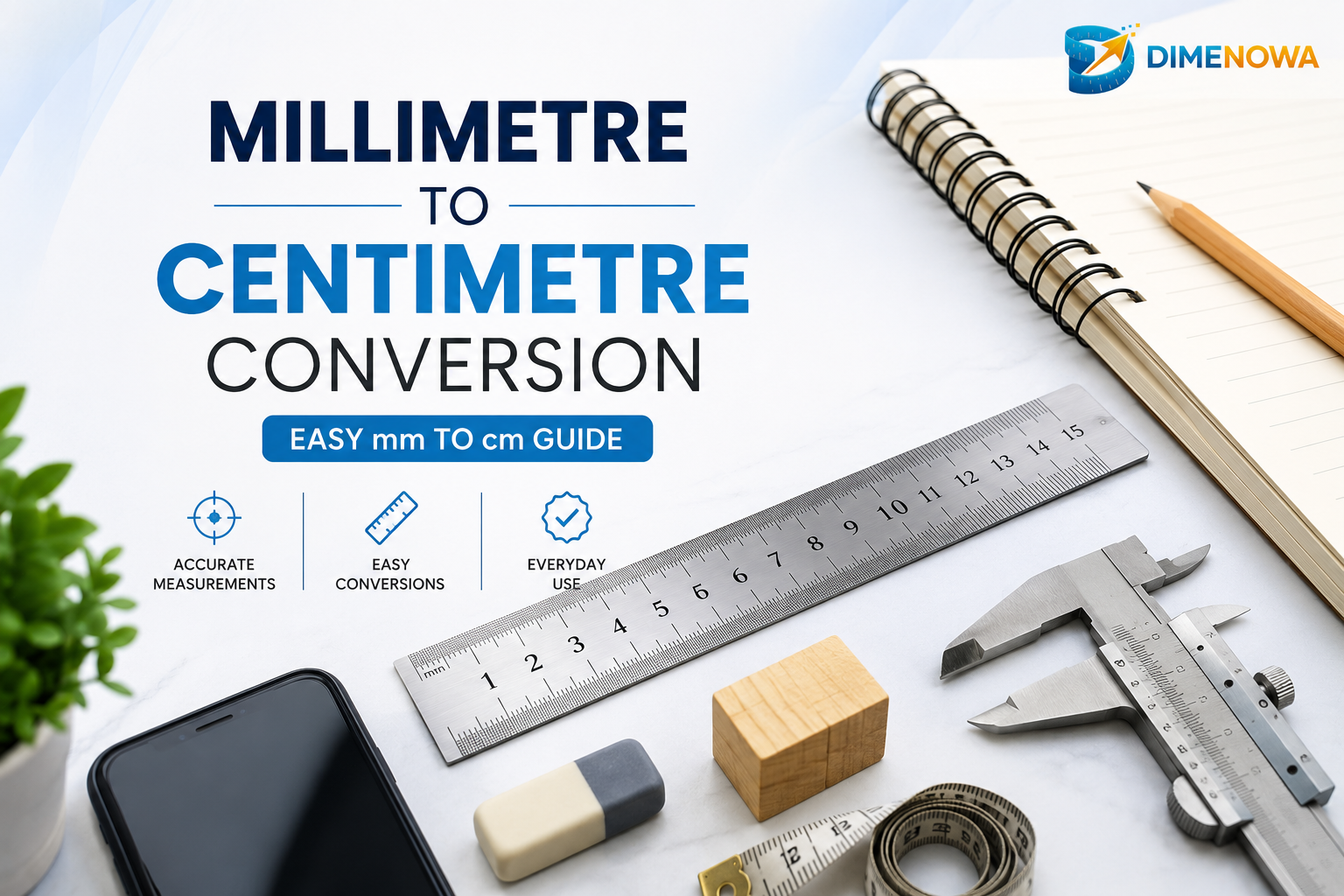
Converting Millimetre to Centimetre is one of the most common unit conversions used in education, engineering, construction, manufacturing, and everyday measurements. Since both units belong to the metric system, converting between them is quick and straightforward.
In this guide, you’ll learn the mm to cm formula, conversion chart, and practical examples to help you measure accurately.
What Is a Millimetre (mm)?
A millimetre (mm) is a metric unit of length equal to one-thousandth of a meter (0.001 m). It is commonly used for measuring small objects and precise dimensions.
Examples include:
- Coin thickness
- Paper thickness
- Small screws and bolts
- Electronic components
- Jewelry measurements
What Is a Centimetre (cm)?
A centimetre (cm) is another metric unit of length equal to one-hundredth of a meter (0.01 m).
Centimetres are commonly used to measure:
- Books
- Mobile phones
- Furniture
- Clothing
- Household items
Since 1 centimetre contains 10 millimetres, converting between these units is very simple.
Learn how to convert inches into centimeters, millimeters, and other common measurement units.
Millimetre to Centimetre Formula
The standard conversion formula is:
Centimetres = Millimetres ÷ 10
Or simply:
1 cm = 10 mm
Examples
- 10 mm = 1 cm
- 25 mm = 2.5 cm
- 50 mm = 5 cm
- 100 mm = 10 cm
Millimetre to Centimetre Conversion Chart
| Millimetres (mm) | Centimetres (cm) |
|---|---|
| 1 mm | 0.1 cm |
| 5 mm | 0.5 cm |
| 10 mm | 1 cm |
| 20 mm | 2 cm |
| 25 mm | 2.5 cm |
| 50 mm | 5 cm |
| 75 mm | 7.5 cm |
| 100 mm | 10 cm |
Instant Millimeters to Centimeters (mm to cm) Converter
mm to cm Converter 📐
Millimeters ya Centimeters enter karein, conversion instantly calculate ho jayegi.
1 Centimeter (cm) = 10 Millimeters (mm)
Formula: cm = mm ÷ 10 | mm = cm × 10
Why This Conversion Matters
Knowing how to convert Millimetre to Centimetre is useful for:
- Reading rulers accurately.
- Measuring household objects.
- Construction and DIY projects.
- Engineering and manufacturing.
- School mathematics and science.
Because both units are part of the metric system, conversions are fast, accurate, and widely accepted worldwide.
Mattress dimensions are often provided in centimeters and millimeters, so our Complete Bed and Mattress Size Guide can help you compare standard bed sizes accurately.”
Practical Millimetre to Centimetre Conversion Examples
Here are some everyday mm to cm conversions that are easy to remember.
| Millimetres (mm) | Centimetres (cm) |
|---|---|
| 15 mm | 1.5 cm |
| 30 mm | 3 cm |
| 45 mm | 4.5 cm |
| 60 mm | 6 cm |
| 80 mm | 8 cm |
| 120 mm | 12 cm |
| 150 mm | 15 cm |
| 250 mm | 25 cm |
These examples are commonly used in schools, construction, product measurements, and engineering.
Learn Standard steel beam sizes commonly used in commercial and public building construction.
Common Uses of Millimetres and Centimetres
Both units are widely used in daily life.
Millimetres (mm) are commonly used for:
- Mechanical parts
- Jewelry dimensions
- Electronics
- Screw and bolt sizes
- Engineering drawings
Centimetres (cm) are commonly used for:
- Books and notebooks
- Furniture dimensions
- Clothing measurements
- Mobile phones and tablets
- Household items
Tips for Accurate Measurement
Follow these simple tips for precise measurements:
- Use a metric ruler with clear mm and cm markings.
- Start measuring from the zero mark.
- Read the ruler at eye level to avoid errors.
- Double-check measurements before recording them.
- Convert mm to cm by simply dividing by 10.
Common Conversion Mistakes
Avoid these common mistakes when converting measurements:
- Forgetting that 10 mm = 1 cm.
- Multiplying instead of dividing by 10.
- Confusing millimetres with centimetres.
- Reading the ruler from the wrong starting point.
- Mixing metric and imperial units in the same calculation.
Understanding these simple rules makes Millimetre to Centimetre conversions quick, accurate, and reliable for everyday use.
Conclusion
Converting Millimetre to Centimetre is simple because both units belong to the metric system. By remembering that 10 millimetres equal 1 centimetre, you can quickly convert measurements for school, construction, engineering, product dimensions, and everyday tasks. Whether you’re measuring furniture, tools, or small objects, understanding this basic conversion ensures greater accuracy and confidence. National Institute of Standards and Technology (NIST) – A trusted source for the International System of Units (SI) and measurement standards.
Frequently Asked Questions
1. How do you convert millimetres to centimetres?
Divide the number of millimetres by 10.
Formula: cm = mm ÷ 10
2. Is 10 mm equal to 1 cm?
Yes. 10 millimetres = 1 centimetre.
3. What is 50 mm in centimetres?
50 mm = 5 cm.
4. What is 100 mm in centimetres?
100 mm = 10 cm.
5. Which is larger, a millimetre or a centimetre?
A centimetre is larger. One centimetre contains 10 millimetres.
6. Where is mm to cm conversion commonly used?
It is commonly used in construction, engineering, education, manufacturing, architecture, and everyday measurements.
7. Can I convert mm to cm without a calculator?
Yes. Simply move the decimal point one place to the left or divide by 10.
8. Why are millimetres used instead of centimetres?
Millimetres provide greater precision when measuring small objects and detailed dimensions.