Box Dimensions: Height, Length & Width Explained
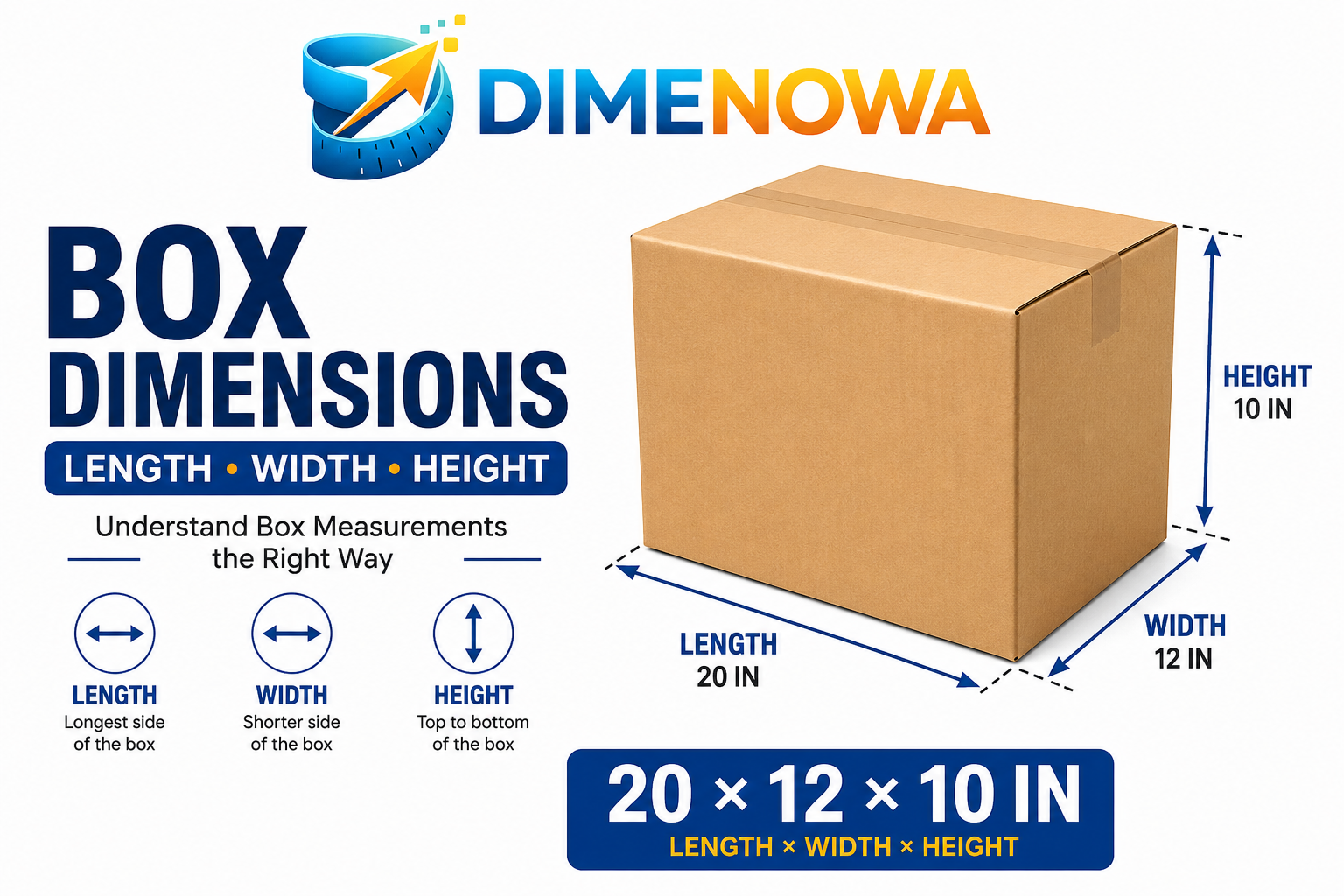
When you see box dimensions such as 20 × 12 × 10 inches, the three numbers describe the box’s length, width, and height. These measurements are important when buying packaging, checking whether a product will fit, calculating box volume, or preparing a package for shipping.
The most common format is Length × Width × Height (L × W × H). However, packaging manufacturers may use Length × Width × Depth (L × W × D), so it is always worth checking how a particular supplier defines its measurements.
Quick Answer: Box Dimensions
| Measurement | Meaning | Example |
|---|---|---|
| Length | Longest dimension of the main face | 20 in |
| Width | Shorter dimension of the main face | 12 in |
| Height/Depth | Third dimension from bottom to top | 10 in |
| Overall size | L × W × H | 20 × 12 × 10 in |
| Volume | L × W × H | 2,400 in³ |
There is no single standard box size for all purposes. Box dimensions vary according to the product, packaging requirements, storage space, and shipping needs.
What Do Length, Width and Height Mean?
Length
Length is generally the longest horizontal dimension of a rectangular box. In corrugated-box terminology, the Fibre Box Association describes length as the larger of the two dimensions of the open face of the box.
For example, if the main face measures 20 × 12 inches, the 20-inch measurement is the length.
Width
Width is the shorter measurement across the main face. In the same example, the width would be 12 inches.
Height
Height is the third dimension and normally describes the distance from the bottom of the box to the top. In packaging terminology, this measurement is also commonly called depth.
Therefore, a box measuring 20 × 12 × 10 inches can be described as:
20 inches long × 12 inches wide × 10 inches high/deep.
How Are Box Dimensions Written?
Box dimensions are normally written in this order:
Length × Width × Height
For example:
50 × 30 × 20 cm
means:
- Length = 50 cm
- Width = 30 cm
- Height = 20 cm
Always check the manufacturer’s specification because some packaging and shipping systems use Length × Width × Depth instead.
If your measurements are given in millimeters, use our Millimeter to Centimeter Conversion guide to quickly convert them before calculating area or volume.
Box Dimensions in Different Units
Box dimensions can be expressed in inches, centimeters, or millimeters.
| Conversion | Equivalent |
|---|---|
| 1 inch | 2.54 cm |
| 1 inch | 25.4 mm |
| 10 inches | 25.4 cm |
| 20 inches | 50.8 cm |
| 1 foot | 12 inches |
| 1 foot | 30.48 cm |
| 100 cm | 1 meter |
For example, a 20 × 12 × 10 inch box is approximately:
50.8 × 30.48 × 25.4 cm
The conversion from inches to centimeters is exact because 1 inch = 2.54 cm.
Common Box Sizes
Boxes come in many sizes, and there is no universal standard size suitable for every product.
| Example Size | Approx. Metric Size | Common Use |
|---|---|---|
| 6 × 6 × 6 in | 15.24 × 15.24 × 15.24 cm | Small products and gifts |
| 10 × 8 × 6 in | 25.4 × 20.32 × 15.24 cm | Small packages |
| 12 × 10 × 8 in | 30.48 × 25.4 × 20.32 cm | Clothing and household items |
| 16 × 12 × 10 in | 40.64 × 30.48 × 25.4 cm | Medium-sized products |
| 20 × 12 × 10 in | 50.8 × 30.48 × 25.4 cm | Larger products and shipping |
These are example box sizes, not universal industry standards. Custom packaging can be manufactured in many different dimensions.
How to Measure a Box
Measuring a box correctly is simple, but you first need to know whether you need its inside or outside dimensions.
Step 1: Measure the Length
Identify the longest dimension of the box’s main face and measure it with a ruler or measuring tape.
Step 2: Measure the Width
Measure the shorter dimension across the same face.
Step 3: Measure the Height
Measure the distance from the bottom of the box to the top.
Step 4: Record the Dimensions
Write the measurements in the required order:
Length × Width × Height
For example:
20 × 12 × 10 inches
For shipping purposes, carriers such as UPS provide specific instructions for measuring package length, width, and height.
Inside vs. Outside Box Dimensions
One important detail is whether the listed measurements are internal or external dimensions.
Inside dimensions represent the usable space inside the box. They are especially important when determining whether a product will fit.
Outside dimensions represent the overall physical size of the finished box. They are useful when calculating storage, transportation, or the space occupied by packages.
When planning a public bathroom layout, understanding Public Bathroom & Toilet Dimensions can help ensure there is enough space for fixtures, movement, and accessibility.
The outside dimensions can be larger because cardboard has thickness. Therefore, a product should not be selected based only on the box’s external measurements.
How to Calculate Box Volume
Box Volume & Surface Area Calculator
Enter the box dimensions below to calculate volume and total surface area.
The volume of a rectangular box is calculated using:
Volume = Length × Width × Height
For example, if a box measures:
20 × 12 × 10 inches
then:
20 × 12 × 10 = 2,400 cubic inches
So the box volume is 2,400 in³.
For a metric box measuring 50 × 30 × 20 cm:
50 × 30 × 20 = 30,000 cm³
Because 1,000 cm³ = 1 liter, this is equal to 30 liters.
If you are interested in measuring other products, you can also check our detailed guide to Pokémon Card Dimensions to learn about their standard size and measurements.
Why Box Dimensions Matter for Shipping
Accurate box dimensions are important when shipping because carriers may consider both the actual weight and the dimensional size of a package.
A large but lightweight package can occupy more transportation space than a small heavy package. For this reason, shipping companies may use dimensional-weight calculations for eligible packages.
USPS and UPS both provide official guidance on package dimensions and shipping calculations.
Choosing a box that is appropriately sized for the product can also reduce unnecessary empty space and the amount of protective packaging required.
Common Box Measurement Mistakes
Measuring the wrong side
Do not automatically assume that the tallest side is length. Identify the three dimensions first.
Confusing inside and outside dimensions
Always check whether a supplier provides internal or external measurements.
Mixing units
Do not calculate volume using inches for one dimension and centimeters for another. Convert all measurements to the same unit first.
Ignoring packaging material
A product may not fit if the box dimensions leave no room for protective material such as paper, foam, or bubble wrap.
For another useful dimensions guide, explore our article on Tennis Racket Dimensions, covering racket length, head size, and other important measurements.
Rounding measurements too much
For shipping and manufacturing, retain accurate measurements rather than rounding them unnecessarily.
Frequently Asked Questions
What is the correct order for box dimensions?
The common order is Length × Width × Height (L × W × H). Some packaging specifications use Length × Width × Depth.
Which measurement is the length of a box?
For many rectangular and corrugated boxes, length is the larger dimension of the main opening or face. Shipping carriers may define length as the longest side.
Is box height the same as depth?
They can describe the same physical direction, but packaging specifications commonly use the term depth while everyday descriptions often use height.
Are box dimensions inside or outside measurements?
They can be either. Always check the product specification before using the dimensions.
How do you calculate box volume?
Multiply the three dimensions:
Length × Width × Height = Volume
All three measurements must use the same unit.
What box size should I use for shipping?
Choose a box that provides enough internal space for the product and necessary protective packaging without leaving excessive empty space.
Conclusion
Box dimensions describe the three-dimensional size of a box using length, width, and height or depth. The common format is L × W × H, such as 20 × 12 × 10 inches.
When measuring a box, always determine whether you need its inside or outside dimensions and keep all measurements in the same unit. You can also calculate its capacity using Length × Width × Height.
Accurate box dimensions are useful for packaging, storage, product fitting, transportation, and shipping calculations.