Area, Perimeter and Volume: Formulas, Examples & Complete Guide
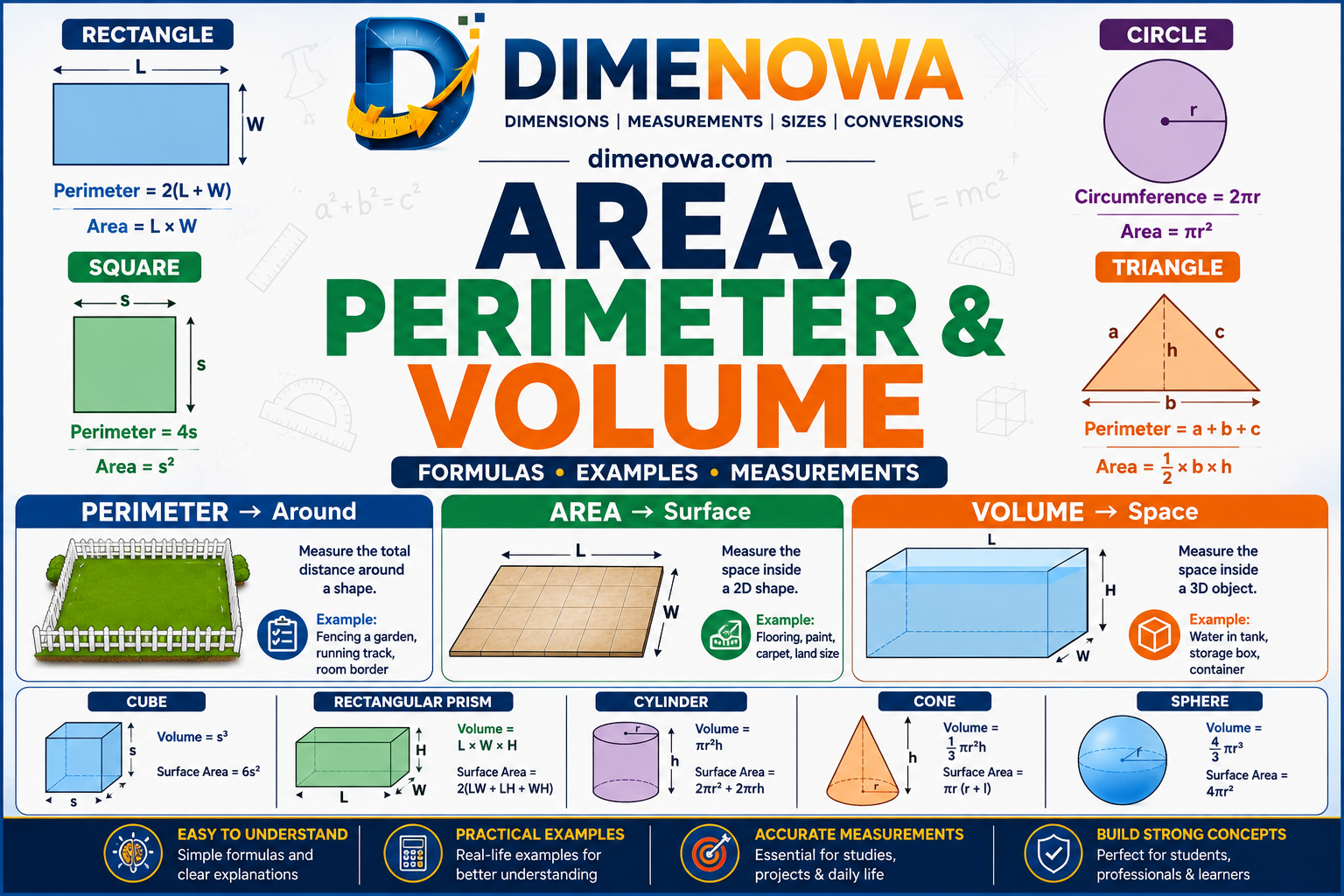
Area, perimeter, and volume are three fundamental measurements used in mathematics, geometry, construction, design, engineering, and everyday life. Although they are related, each describes something different: perimeter measures the distance around a two-dimensional shape, area measures the surface covered by a two-dimensional shape, and volume measures the three-dimensional space occupied by an object.
Understanding the difference between these measurements makes it easier to solve geometry problems and practical measurement tasks. For example, you might use perimeter to determine how much fencing is needed around a yard, area to calculate how much flooring is required, and volume to estimate how much water a tank can hold.
This guide explains the most important area, perimeter, and volume formulas, shows how to use them with real examples, and explains the units used for each measurement.
Quick Answer: Area, Perimeter and Volume
| Measurement | What It Measures | Typical Unit |
|---|---|---|
| Perimeter | Distance around a 2D shape | m, cm, ft, in |
| Area | Surface covered by a 2D shape | m², cm², ft², in² |
| Volume | Space occupied by a 3D object | m³, cm³, ft³, in³ |
The key difference is the type of measurement:
- Perimeter = boundary
- Area = surface
- Volume = space
Area is expressed in square units, while volume is expressed in cubic units. The SI units are square meter (m²) for area and cubic meter (m³) for volume.
What Is Perimeter?
Perimeter is the total distance around the outside boundary of a two-dimensional shape.
To calculate the perimeter of a polygon, add the lengths of all its sides.
For example, if a rectangle has a length of 10 meters and a width of 6 meters:
P = 2L + 2W
P = 2(10) + 2(6)
P = 32 m
Perimeter is useful when you need to measure a boundary, such as fencing around a property, edging around a garden, or the outside dimensions of a floor plan.
For a circle, the equivalent measurement around the boundary is called circumference rather than perimeter.
What Is Area?
Area measures how much two-dimensional surface a shape covers.
For example, the area of a rectangular floor tells you how much floor space it covers. The SI unit of area is the square meter (m²). Other common units include square centimeters, square inches, square feet, and square yards.
The basic rectangle formula is:
A = L × W
If a room is 8 meters long and 5 meters wide:
A = 8 × 5
A = 40 m²
This means the room covers 40 square meters of floor area.
What Is Volume?
Volume measures the amount of three-dimensional space occupied by an object or enclosed by a surface.
Volume is expressed in cubic units, such as cubic meters (m³), cubic centimeters (cm³), cubic feet (ft³), and cubic inches (in³).
For a rectangular box:
V = L × W × H
For example, a storage box measuring 2 m × 1.5 m × 1 m has:
V = 2 × 1.5 × 1
V = 3 m³
So the box has a volume of 3 cubic meters.
Area, Perimeter and Volume Formulas
Different shapes require different formulas. The following tables provide the most commonly used formulas.
Rectangle
A rectangle has two pairs of equal sides.
Perimeter
P = 2(L + W)
Area
A = L × W
Example
For a rectangle measuring 12 cm × 7 cm:
Perimeter = 2(12 + 7) = 38 cm
Area = 12 × 7 = 84 cm²
Square
A square has four equal sides.
Perimeter
P = 4s
Area
A = s²
where s represents the side length.
Example
If a square has a side length of 5 m:
P = 4 × 5 = 20 m
A = 5² = 25 m²
The standard square formulas are also given by OpenStax’s geometry reference materials.
Triangle
A triangle has three sides.
Perimeter
P = a + b + c
Area
A = ½ × b × h
where:
- b = base
- h = perpendicular height
Example
A triangle has a base of 10 cm and a height of 6 cm.
Area = ½ × 10 × 6
Area = 30 cm²
If its three sides are 8 cm, 9 cm, and 10 cm:
Perimeter = 8 + 9 + 10 = 27 cm
OpenStax lists the same basic triangle perimeter and area relationships.
Circle
A circle uses radius (r) and diameter (d) rather than length and width.
Circumference
C = 2πr
or
C = πd
Area
A = πr²
Example
For a circle with a radius of 4 cm:
Circumference = 2 × π × 4 ≈ 25.13 cm
Area = π × 4² ≈ 50.27 cm²
The circumference and area formulas for a circle are standard geometry formulas.
If your measurements are given in millimeters, use our Millimeter to Centimeter Conversion guide to quickly convert them before calculating area or volume.
Common 2D Shape Formulas
| Shape | Perimeter / Circumference | Area |
|---|---|---|
| Square | 4s | s² |
| Rectangle | 2(L + W) | L × W |
| Triangle | a + b + c | ½bh |
| Circle | 2πr or πd | πr² |
| Parallelogram | 2(a + b) | bh |
| Trapezoid | Sum of all sides | ½(a + b)h |
These formulas cover many of the shapes encountered in school mathematics, construction measurements, and everyday calculations.
Volume Formulas for Common 3D Shapes
Perimeter and area describe two-dimensional measurements, while volume applies to three-dimensional objects.
Rectangular Prism
A rectangular prism is a box-shaped object.
Volume
V = L × W × H
Surface Area
SA = 2(LW + LH + WH)
Example
For a box measuring 10 m × 4 m × 3 m:
V = 10 × 4 × 3
V = 120 m³
Its surface area is:
SA = 2[(10 × 4) + (10 × 3) + (4 × 3)]
SA = 164 m²
Cube
All six sides of a cube are equal squares.
Volume
V = s³
Surface Area
SA = 6s²
For a cube with a side length of 3 m:
V = 3³ = 27 m³
SA = 6 × 3² = 54 m²
Cylinder
A cylinder has a circular base and a height.
Volume
V = πr²h
Total Surface Area
SA = 2πr² + 2πrh
For a cylinder with radius 2 m and height 5 m:
V = π × 2² × 5
V ≈ 62.83 m³
OpenStax provides these standard cylinder volume and surface-area formulas.
Cone
Volume
V = ⅓πr²h
For a cone with a radius of 3 m and height of 4 m:
V = ⅓ × π × 3² × 4
V = 12π
V ≈ 37.70 m³
Sphere
A sphere has a radius extending from its center to its surface.
Volume
V = ⁴⁄₃πr³
Surface Area
SA = 4πr²
For a sphere with a radius of 3 m:
V = ⁴⁄₃ × π × 3³
V ≈ 113.10 m³
The standard sphere formulas are documented in OpenStax geometry references.
Area, Perimeter and Volume in Different Units
One of the most important things to understand is that length, area, and volume do not convert in the same way.
Length
1 m = 100 cm
1 m = 1,000 mm
1 inch = 2.54 cm
1 foot = 0.3048 m
NIST identifies the meter as the SI unit of length and provides these metric and U.S. customary conversion relationships.
Area
Because area is two-dimensional, conversion factors are squared.
1 m² = 10,000 cm²
1 m² ≈ 10.7639 ft²
1 ft² = 0.09290304 m²
NIST lists square-foot and square-inch conversion factors to square meters and square centimeters.
Volume
Volume uses cubic units.
1 m³ = 1,000,000 cm³
1 m³ = 1,000 L
1 L = 1,000 cm³
1 ft³ ≈ 0.0283168 m³
NIST confirms that 1,000 liters equal 1 cubic meter and that 1 liter equals 1,000 cubic centimeters.
You can apply these same area and perimeter concepts to real sports facilities by exploring our guide to Tennis Court Dimensions
Quick Conversion Table
| Quantity | Metric Relationship | Common Imperial Conversion |
|---|---|---|
| Length | 1 m = 100 cm | 1 m ≈ 3.28084 ft |
| Area | 1 m² = 10,000 cm² | 1 m² ≈ 10.7639 ft² |
| Volume | 1 m³ = 1,000,000 cm³ | 1 m³ ≈ 35.3147 ft³ |
Why Units Matter in Area and Volume
A common mistake is converting the dimensions but forgetting that area and volume are calculated differently.
Suppose a square has sides of 1 meter.
Its area is:
1 m × 1 m = 1 m²
Since 1 meter equals 100 centimeters:
100 cm × 100 cm = 10,000 cm²
Therefore:
1 m² = 10,000 cm²
The same principle becomes even more significant for volume.
A cube measuring 1 meter on every side has:
1 m × 1 m × 1 m = 1 m³
In centimeters:
100 × 100 × 100 = 1,000,000 cm³
So:
1 m³ = 1,000,000 cm³
NIST specifically recommends expressing all dimensions in the same unit before calculating area or volume.
How to Calculate Area, Perimeter and Volume
Use the following process for most geometry problems.
Step 1: Identify the Shape
Determine whether you are working with a square, rectangle, triangle, circle, cube, cylinder, or another shape.
Step 2: Identify the Required Measurement
Ask whether the problem requires:
- Perimeter
- Area
- Surface area
- Volume
- Circumference
Do not confuse surface area with volume.
Step 3: Check the Units
Make sure all dimensions use the same unit before inserting them into a formula.
Step 4: Choose the Correct Formula
For example:
Rectangle area = L × W
Rectangle perimeter = 2(L + W)
Rectangular prism volume = L × W × H
Step 5: Substitute the Measurements
Insert the known dimensions into the formula.
Step 6: Calculate and Add the Correct Unit
Use:
- Linear units for perimeter
- Square units for area
- Cubic units for volume
Real-World Uses of Area, Perimeter and Volume
These measurements are not limited to classroom mathematics.
Area
Area can help determine:
- Flooring requirements
- Wall or ceiling coverage
- Paint coverage
- Land size
- Carpet requirements
- Garden space
- Sports playing areas
NIST also gives practical examples such as calculating floor area for purchasing carpet.
Perimeter
Perimeter is useful for:
- Fencing
- Borders
- Garden edging
- Room boundaries
- Track boundaries
- Framing
Volume
Volume is commonly used for:
- Water tanks
- Swimming pools
- Storage containers
- Boxes
- Fuel tanks
- Concrete calculations
- Shipping containers
NIST notes that volume calculations are useful for applications including storage containers, beverages, fuel, and other everyday measurement tasks.
When planning a public bathroom layout, understanding Public Bathroom & Toilet Dimensions can help ensure there is enough space for fixtures, movement, and accessibility.
Area vs Perimeter vs Volume
| Feature | Perimeter | Area | Volume |
|---|---|---|---|
| Dimension | 2D boundary | 2D surface | 3D space |
| Measures | Distance around | Surface covered | Space occupied |
| Units | m, cm, ft, in | m², cm², ft² | m³, cm³, ft³ |
| Example | Fence around yard | Floor space | Water in a tank |
| Typical formulas | Add sides | Multiply dimensions or use shape formula | Multiply 3D dimensions or use solid formula |
The easiest way to remember the difference is:
Perimeter goes around.
Area covers a surface.
Volume fills a space.
Common Measurement Mistakes
1. Mixing Units
Using 5 meters with 20 centimeters in the same formula produces an incorrect result unless the units are converted first.
Convert everything to the same unit before calculating.
2. Using Linear Units for Area
An area answer should not be written simply as 25 m.
It should be:
25 m²
3. Using Square Units for Volume
A volume answer should use cubic units.
For example:
50 m³, not 50 m².
4. Confusing Diameter and Radius
For a circle:
d = 2r
If the diameter is 10 cm, the radius is 5 cm.
Using the diameter directly in the radius-based area formula will give the wrong result.
5. Confusing Surface Area With Volume
Surface area describes the outside surfaces of a three-dimensional object.
Volume describes the space inside it.
A box can therefore have both a surface area and a volume, but they represent different quantities.
6. Forgetting to Square or Cube Conversion Factors
Converting 1 meter to 100 centimeters is correct for length, but:
1 m² = 10,000 cm²
and:
1 m³ = 1,000,000 cm³
This is one of the most important differences between length, area, and volume conversions.
Real-World Example: Measuring a Room
Suppose a rectangular room is:
6 m long × 4 m wide
Perimeter
P = 2(6 + 4)
P = 20 m
So you would need 20 meters of boundary length to go around the room, ignoring doors or other openings.
Area
A = 6 × 4
A = 24 m²
So the room has 24 square meters of floor area.
If the room were 3 meters high and you wanted its rectangular-prism volume:
V = 6 × 4 × 3
V = 72 m³
The same dimensions can therefore produce three different useful measurements depending on what you are trying to determine.
What Is the Difference Between Area and Volume?
Area measures a two-dimensional surface, while volume measures three-dimensional space.
For example, the floor of a room has an area. If you consider the entire room’s length, width, and height, you can calculate its volume.
This distinction is important when selecting materials or calculating capacity.
- Flooring → Area
- Fencing → Perimeter
- Water capacity → Volume
Can Area, Perimeter and Volume Be Calculated for Irregular Shapes?
Yes, but the method depends on the shape.
For an irregular two-dimensional shape, you may be able to divide it into familiar shapes such as rectangles and triangles, calculate each part separately, and then combine the results.
For irregular three-dimensional objects, volume may require decomposition into simpler solids, measurement of displaced liquid, or more advanced mathematical methods depending on the object.
For collectors and storage planning, knowing the Pokémon card dimensions can help you choose the right sleeves, binders, card holders, and storage boxes.
The key principle remains the same: identify the geometry and use a measurement method appropriate to that shape.
When Should You Use an Area, Perimeter or Volume Calculator?
A calculator or geometry tool is particularly useful when:
- The dimensions contain decimals
- You need several calculations
- The shape contains multiple sections
- You need unit conversions
- You want to reduce arithmetic errors
- You are comparing different dimensions
For simple shapes, however, understanding the formula is more important than simply entering numbers into a calculator. A calculator should confirm the calculation rather than replace understanding of the measurement.
Confirms the square meter as the SI unit for area and explains common square-unit relationships.
7. FAQ Section
What is the difference between area, perimeter and volume?
Perimeter measures the distance around a two-dimensional shape, area measures the surface covered by a two-dimensional shape, and volume measures the three-dimensional space occupied by an object.
What is the formula for area?
The formula depends on the shape. For a rectangle, A = L × W. For a square, A = s². For a triangle, A = ½bh, and for a circle, A = πr².
What is the formula for perimeter?
For a rectangle, the formula is P = 2(L + W). For a square, it is P = 4s. For a triangle, add the three side lengths. For a circle, the corresponding boundary measurement is circumference: C = 2πr or C = πd.
What is the formula for volume?
The formula depends on the three-dimensional shape. A rectangular prism uses V = L × W × H, a cylinder uses V = πr²h, a cone uses V = ⅓πr²h, and a sphere uses V = ⁴⁄₃πr³.
What units are used for area?
Area is measured in square units, including square meters (m²), square centimeters (cm²), square feet (ft²), and square inches (in²). The SI unit is the square meter.
What units are used for volume?
Volume is measured in cubic units such as m³, cm³, ft³, and in³. Liters and milliliters are also commonly used for capacity. NIST states that 1 liter equals 1,000 cm³ and 1,000 liters equals 1 m³.
Can the same dimensions be used to calculate area and volume?
Yes, but only when the object has enough dimensions for the measurement. A rectangle needs length and width for area, while a rectangular prism needs length, width, and height for volume.
Why do area and volume conversions use different factors?
Area is two-dimensional, so the conversion factor is squared. Volume is three-dimensional, so the conversion factor is cubed. For example, 1 m² equals 10,000 cm², while 1 m³ equals 1,000,000 cm³.
Conclusion
Understanding area, perimeter, and volume makes it easier to solve everyday measurement and geometry problems. By using the correct formulas and units, you can accurately calculate the size, boundary, or space occupied by different shapes and objects.